Volume 1
The elements of that mathematical art commonly called algebra, expounded in four books / By John Kersey.
- John Kersey the elder
- Date:
- 1673
Licence: Public Domain Mark
Credit: The elements of that mathematical art commonly called algebra, expounded in four books / By John Kersey. Source: Wellcome Collection.
263/350 (page 243)
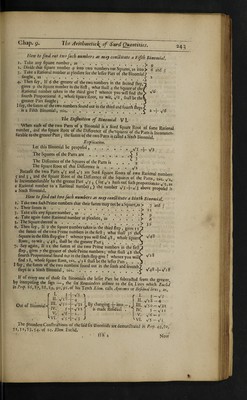
![H V6 How to find out two fitch numbers as may conUitute a Fifth Binomial 1. Take any fquare number, as ... .. . C 2. Divide that fquare number 9 into two numbers not Squares,*as into > ^ 3. Take a Rationai number at pleafure for the Icfler Part of the Binomial? fought, as.. ^ ^ ^ .j. Then fay, If 6 the greater of the two numbers in the fecond flep* gives 9 the fquare number in the firft 5 what lhall 4 the Square of thei Rational number taken in the third give ? whence you will find the fourth Proportional 5, whofe fquare Root, to wit, , lliall be thel greater Part fought... I fay, the fumm of the two numbers found out in the third and fourth fteps ? is a Fifth Binomial, vIk.. r 2 -j- The. Definition of Binomial V I. When each of the two Parts of a Binomial is a Surd fquare Root of fome Ration;,! number, and the fqwe Root of the Difference of the SquLs of the Parts is IncoZen- furable to the greater Part; the fumm of the two Parts is called a Sixth Binomial. Exfi.icati(in. ; Let this Binbmial be propofed, , . f f . vj -1- v'3 The Difference of the Squares of the Parts is ...z- Becaufe the two Parts VS and V? are Surd fquare Roots of two Rational namberc y and 3 5 and the fquare Root of the Difference of the Squares of the Parts viz A IS Incommenfurable to the greater Part Vj; ( for y/z hath nof fuch proportio^o J, as a ixih BinomTa^“ “ a'R«ional number,) the number Vf+^.3 above propofed is Horv to find out troofuch numbers as maj ceniiitute a sixth BinemiaK U Take two fuchPrime numbers that their fumm may not be afiquare,as > 7 anil c 2. Their fumm is.. .J> 12 ^ 3. Take alfo any fquare number, as.o ' 4. Take again fome Rational number at pleafure, as' .* .* * e. Then fay, If 9 the fquare pumber taken in the third ftep , gives iz' the fumm of the two Prime numbers in the firft ; what lhall 36 the( ' Square in the fifth flep give ? whence you will find 48 , whofe fduare( Root, to wit, 0/48, fliall be the greater Part. . .... 7. Say again, If 12 the fumm of the two Prime numbers in the firfi' ftep, gives 7 the greater of thofe Prime numbers; what fiiail 48 the{ fourth Proportional found out in the fixth flep give ? whence you willl find 2 8, whofe fquare Root, viz. ^2 8 fliall be the leflfer Part . I fay, the fumm of the two numbers found out in the Iixth and Icvcnth? Reps' is a Sixth Binomial, viz.j 8 If of every one of thofe fix Binomials the lefTer Part be fubtra<Red from the greater by interpoling the fign —, the fix Remainders anfwer to the fix Lines which Euclid in Prep. 85, 87, 88, 89, 90,'91. of his Tenth Elem. calls Apotoms or RefUuallir.es ; as, f I . Out of Binomial !Ih -]-V3a L By changing-b-imo -III. Vso-Vja [ iv. is made Refidual . ] IV. V4S -y/ 2 8 *j 6 2 Vs-] /5 .^6 1 Vs — V i. Jhe precedent Confiru^Iions of the faid fix Binomials arc demonfirated in Prop. AoAoiy of 10. Euclid. ^ . . * H h 2 Now % cr\](https://iiif.wellcomecollection.org/image/b30333726_0001_0263.jp2/full/800%2C/0/default.jpg)