Volume 1
The elements of that mathematical art commonly called algebra, expounded in four books / By John Kersey.
- John Kersey the elder
- Date:
- 1673
Licence: Public Domain Mark
Credit: The elements of that mathematical art commonly called algebra, expounded in four books / By John Kersey. Source: Wellcome Collection.
273/350 (page 253)
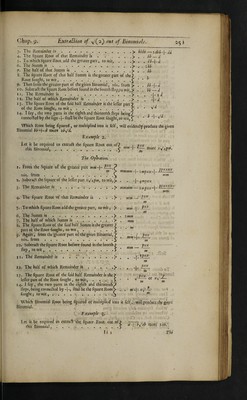
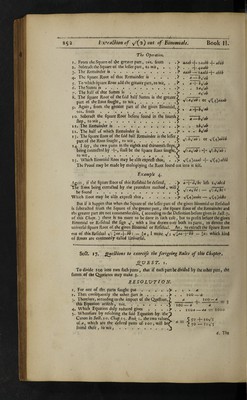
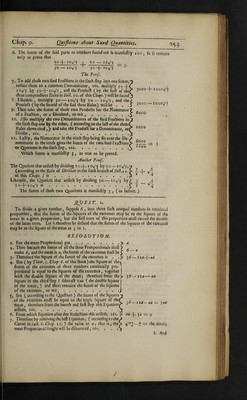
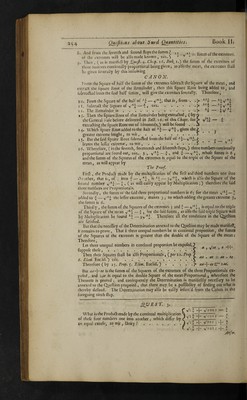
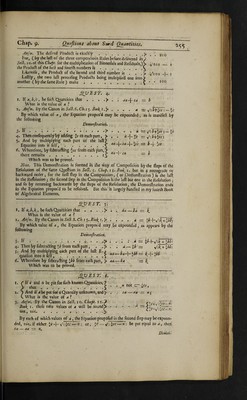
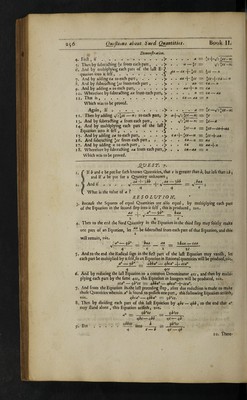
![^53 3000 loao- 6. The fumm of the faid parts or numbers found out is manifefily ibo, fo it remains only to prove that so . SO — 10^5 __ 50—loy'f JO 4-lo-y/j The. Proof. 7. To idd thofc two furd Fraftions in the fixth ftep into one furtimi reduce them to a common Denominator, viz,, multiply so -l-( toy's t>y JO-1-10^5, and the Product (by the firft of thei three compendious Rules in Sell, i o. of this Chaft.) will be found 8. Llkcwife , multiply $0—toy's by 50 — 10^5, and the? Produd ( by the fecorid of the faid three Rules) will be . , .5 3000 loooy'5 9. Then take the fumm of thofc two Produits tor the Numerator ? of a Fraction, or a Dividend ^ to wit..J I o. Alfo multiply the two Denominators of the furd Fra£tions in the fixth ftep one by the other, ( according to the laft of the three( Rules above cited,) and take the Product for a Denominator, or( • Divifor, viz. II. Laftly, the Numerator in the ninth ftep being fet over the De-, nominator in the tenth gives the fumm 01 the two furd Fractions] or Quotients in the fixth ftep, viz. Which fumm is manifeftly 3, as was to be proved. jinothef Proof. The Quotient that arifeth by dividing 5 o i Oy/y by s o — i oy'y,^ (according to the Rule of Divifion in the fixth branch of S'e^.i j. > i. y'j of this Chap, j is . . . i . i ^ Likewife, the Quotient that arifeth by dividing yo—icy's 3 y o ' j I o yis • .'.i ^ z ^ The fumm of thofc two Quotients is manifeftly 3 5 ( as before.) dooo 2060 dooo i 2000 ^VTsr. 2i To divide a given number, fuppofe 6 , into three fuch unequal numbers in continual proportion , that the fumm of the Squares of the extremes may be to the Square of the mean in a given proportion • but the firft term of this proporiion muft exceed the double of the latter term. Let it therefore be defired that the fumm of the Squares of the extremei may be to the Square of the mean as 3 to i. RMSO LVTIO N- Xi For the mean Proportional put • • • • * . . . 4 2, Then bCcaufcthe fummof allihethrcePronportionalsmuft^ ^ make 6, and the mean is 4, the fumm of the extremes (hall be ^ ‘ ^ 3i Therefore the Square of the fumm of the extremes is • 3d — 124-j-44 4. But ( by Theoi'. 3. Chap. 6. of this Book) the Square of the| fumm of the extremes of three numbers continually pro- I portional is equal to the Squares of the extremes, together | with the double Square of the mean; therefore frohj the}> 3d Square in the third ftep 1 fubtraft in/i (the double Square ot the mean, ) and there remains the fumm of the Squares of the extremes, to wit,.i . . . • y. But ( according to the C^eftioh ) the fumm of the Squares of the exifemes muft be equal to the triple Square of the mean • therefore from the fourth and firft ftep this Equation arifeth, ifiz. , ' .... From which Equation after dile Reduftion this arifeth, viz. 'J. Therefore by refolving the laft Equation, ( according to the Canon in Sell. 6, Chap. 1 y. ) the value ot 4 , that is, the mean Proportional fought will be difeovered , . . i ita 3d— I 24— 44 == 344 44 -j- 34 trr 9 th^ riieahjf 8/ And J](https://iiif.wellcomecollection.org/image/b30333726_0001_0273.jp2/full/800%2C/0/default.jpg)