Volume 1
The elements of that mathematical art commonly called algebra, expounded in four books / By John Kersey.
- John Kersey the elder
- Date:
- 1673
Licence: Public Domain Mark
Credit: The elements of that mathematical art commonly called algebra, expounded in four books / By John Kersey. Source: Wellcome Collection.
275/350 (page 255)
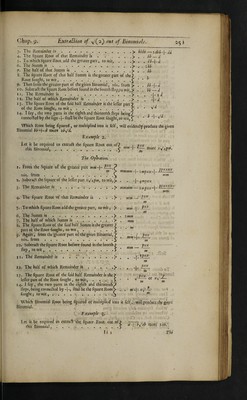
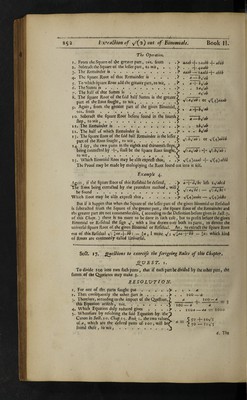
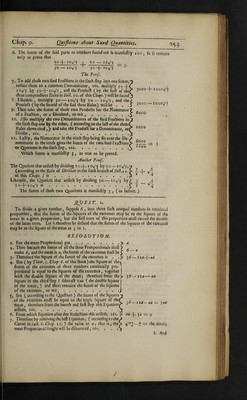
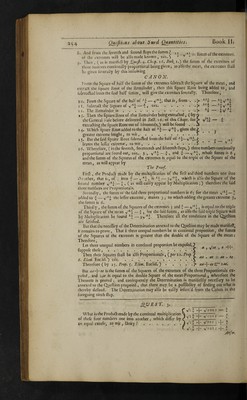
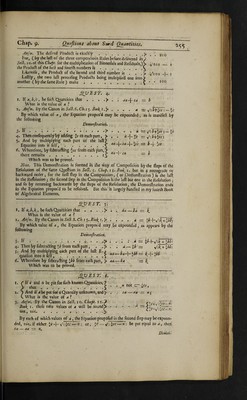
![>^.Xvv ' •* •'V,'; C>ll3p« QHefiiorji abont Sptrd O^antities^ ^55 ICO ^roi — 1 . .Ahfw. The defired ProdUft is exa^ly . ..... . .^ For, ( by the laft of the three compendious Rules before.'delivered in Sec^^ I o.of this Chap, for the multiplication of Binomials and Rcfiduals,)^ the Produft of the firft and fourth numbers is ..^ Likewife, the Produft of the fccond aild third niimber is . . .}> yiox r Laftly, the two lafl preceding Products being multiplied one into 7 another ( by the fame Rule ) make ..\ lOO £>V^ST. 4i 1. If4,be fu'ch Quantities that . . . . What is the value of 4 ? t- T ' t 2. Anftv^ By the Canon m SeB.6.ChA’^. Book^i^^ .. 44 *-1— C4 h 4 ibt^cir: — ~c ^'ci -j- ca. = h By which value of a , thr Equation propos'd may be expounded, as is manifcfl by the tollot^ing Demonftration,,, . ■ * 3« If • • i • • i i i 4 t= — 4. Thwconfequehtlyby adding tb each part, >> • . — .^-.b-kricci ' And by multiplying each part of the laft? • 1 - 1 • • f . 1 ' Equation into it felf, , . . . . . . .f -]rca 6, Wherefore, by fUbtradiing froin each part, there remains .... Which was to be proved. Note. This DemonRration is formed ih the way of Compofition by the ftepsofthe Refolution of iheTaitic Q^eftion in Se^. j. ChAp i p. Book^ i. but in a retrograde or backward order; for the firfl: ftep in the Corapolition; ( or DetiionRration ) is the laft in the Refolution ; the fecond ficp in the Compofition is the laft biit one in thc.Refolution; and fo by returning baekwards by the fteps of the Refolution, the Demonftration ends in the Equation propos’d to be refolvcd. But this is largely handled in my fourth Book bf Algebraical Elements. J^EST, 5^ , 1, If 4,^, be fuchQuafitities that . • . . 1> i . 4a—ba z= What is the value of 4 ? ' - • - __. 2. Aptfw. By th&C^nonmSe^.S.Ch.i$,Bool>^u'r^. I » 4 — + \b$i By which value of a, the Equation propos’d may Be expohrided ^ as appears by the following Vemonflratiori, 3* if • *•***<• • • • 'i. • • • • 4 ~ + 4^^* 4; Then by fubtfadling from each part j . ; 4 — Ih z=. y/*4 + \hfi ;; And by,multiplying each part oi the laft E-f. Wherefore by fubtradling from'eath part, ^ 44 — ^4 '=4 Which was t6 be proved. -) t- . ^ « not cr cA —44 icc^ 1. C If c and n be put for luch known Quamities^ i j that ..... .' ..... i * 2. S And if d be put fof i Quantity unknown, and ^ . C What is the value of 4 ? , 3. Anfw, 'By the Canon in SiSi. 10, Chaft. 15*^ .■ Book^ 1. thefe tWo values of 4 will be ibund^ Out ^ • •• • 4 % ••• By each of which values of 4, the Equation propbled in the fecond fiep may be expoun¬ ded, viz. if cither or, {c — ^'.\cc-^n’. be put equal to 4, then cn — aa H, lieiHori^ '-4 == /.](https://iiif.wellcomecollection.org/image/b30333726_0001_0275.jp2/full/800%2C/0/default.jpg)