Volume 1
The elements of that mathematical art commonly called algebra, expounded in four books / By John Kersey.
- John Kersey the elder
- Date:
- 1673
Licence: Public Domain Mark
Credit: The elements of that mathematical art commonly called algebra, expounded in four books / By John Kersey. Source: Wellcome Collection.
281/350 (page 261)
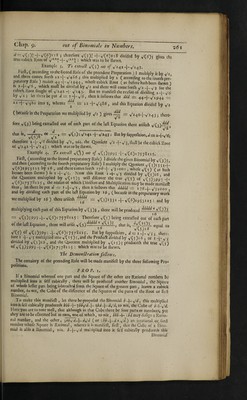
![Chi 265 VCOt-hVCOi^S ; therefore V(?)r-h V('^)ii8 divided by JC6)k gives the true cubick Root of H- J ^ which was to be Hiewn. ^ ^ Example 5. ' To extmU ^(3) out of ^242 Firfl, ( according to the fecond Rule of the precedent Preparation ) I multiply it by Ji and there comes forth 22.-j-v'486 j this multiplied by 2 (according to the fourth pre¬ paratory Rule ) makes 44 ^ 1944, vvhofe cubick Root ( as before hath been fliewn ) IS 2 ^6 , which rauft'be divided by and there will come forth ^2 -4- V3 for the cnb’ck Root fought of V242 -1- ^^43- to manifeft the reafon of dividing 2 J6 by y z; let there be put = 2-|-, then it follows that ddd ~ 44-j-'Vi‘?44 = into 2, whence ^ — 22 -1-v'48<^, and this Equation divided by ( bccaufe in the Preparation we multiplied by ^2 ) gives — = . there- fore VC 3) being extrafted out of each part of the lafl Equation there arifeth ’ d d '— --- y{(6)8’ “ V(3)* V'2'4X-j-v^43 > Butbyfuppofition,«i=:2-|-^(Jj therefore 2divided by ^2, vii. the Qiiotient 'h-v/3, Hiall be the Cubick Root of y'242 ^2 43 : Which was to be Ihewn. Example 4. To extraB V(* ) out of V(3)3993 “HV(^)i7578i25: FirR, (according to the fecond preparatory Rule) I divide the given Binomial by y'(3) ? and then (according to the fourth preparatory Rule) I multiply the Quotient V(3)i 3 3 V'(6)i9ni^5 by 16, and there comes forth 17^+^32000 , whofe y/(5)‘(as hath beiore been fiiewn ) is i Now this Root 1 4-^5 divided by and the Quotient multiplied by VO 5)3 will difeover the true V()). of V(3)^993 -0 A/(6)t7578i 2 5-. the reafon of which Divifion and Multiplication may be maderaanifeft thus ; let there be put = i+Vs, then it follows that ddddd = i ydU-, y'^iooo - and by dividing each part of the laR Equation by 16, ( becaufe in the preparatory work we multiplied by i6) therearifeth - VCOiSSt-4-^(6)1953125 : and by multiplying each part of this Equation by V( 3)3 , there will he pmdnrpr^ ^ V(3 )3 16 — VC3)3993 ^VC<5)1757^115 •• Therefore V(7) being extraded out of each part of the laft Equation, there will arife V(5)^‘^^^‘^ ^ VC 3)3 ^ equal to i<5 V(5)i<5 ^ V(5) of V(3)399M-V(^)*7578i2 But by fiippofition, d—i^]^^^; there¬ fore! -)-V5 touUipliedinto VCi5)3}and iheProduddividedby V(5)i6 ; or I^-^V5 divided by v(5)i6 , and the Quotient multiplied by V(i 5)3 prodiiceth the true V(5) of V(5)S993 + V(^)i757Sii5 • Which was to be fhewn. The DemonUration follows. The certainty of the preceding Rule will be made manifeft by the three following Pro-* pofitions. PROP, 1, If a Binomial whereof one part and the Square of the other are Rational numbers be multiplied into it felf cubically , there will be produced another Binomial, the Square of whofe leffer part being fubtraded from the Square of the greater parr, leaves a cubick number, to wit, the Cube of the ditference of the Squares of the parts of the Root or firfl Binomial. To make this manifefl:, let there be propofed the Binomial I .-j- ^d, this multiplied into it felf cubically produceih bbb '^bb^d~\~^ ^bd~fd^d, to wit, the Cube of ^-l-V^. ' Here you are to note well, that although in that Cube there be four parts or members, yet they are to be edeemed but as two, one of which, to wit, -f- 3 may defign a Ratio¬ nal number, and the other, ^hbi^ d^\-~ d^d (or 3 di x y'J ) an irrational or furd number whofe Square is Rational; whence it is manifeft, firfi:, that the Cube of a Hino- mial is alfo a Binomial, vi^, b^-f^^^d multiplied into it felf cubically prcduceth this Binomial](https://iiif.wellcomecollection.org/image/b30333726_0001_0281.jp2/full/800%2C/0/default.jpg)