Volume 1
The elements of that mathematical art commonly called algebra, expounded in four books / By John Kersey.
- John Kersey the elder
- Date:
- 1673
Licence: Public Domain Mark
Credit: The elements of that mathematical art commonly called algebra, expounded in four books / By John Kersey. Source: Wellcome Collection.
283/350 (page 263)
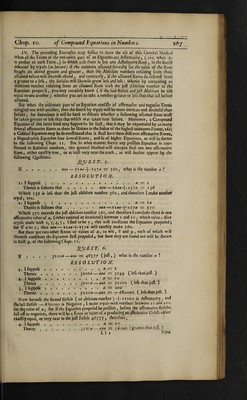
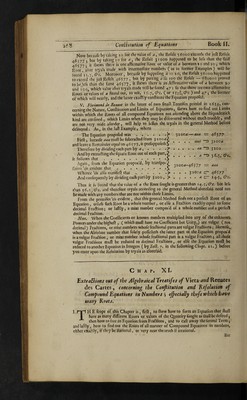
![1 chap. p. <• ont of Bifiomtals w Numbers, « + <?, and lefs than b; and confequently the Numerator 2be-\-^l;h is Icfs than the Denominator wherefore -f'— is lefs than i. After the fame manner it may be proved that a-\- ’e^ h-~~ is greater ^ e *~[~ b than 2 i?. but this excefs alfo fliall be lefs than i; which was ro be fliewn. ^ Now to apply the preceding three Propofiiions ro the Demonflration of the Rule before given, let it be required toextradjthe cubickRoot out of the Binomial ioo-j-^^780^, whofe Rational part 10® is greater than the other part ^'780^. Here wemayfuppofe hbb -{- ^ bd to be 100, and (or ^bb-\<d x be ^7^03 > fo that Uh^y ^bd more ^bb ^/d may defign the given Binomial too -{--.y'7803 ; and its Cubick root the Root fought, whofe greater part may be and thelelTer yds Jhen, according to the Rule To extraSl V(3) f • • loo*-]-' Firft, from the Square of I GO , that is, from i • • 1> lOoob • Subtraft the Square of v'y 803,‘that is,.^ 7803. The Remainder is.*.j> 2197 The Gubick root of that Remainder is . . . . * ^ 13 { ~ bb — d.) Which Root \ 3 is (by Prop» i.) equal to the difference of the Squares of the parts of the Binomial root fought. Secondly, fihd out a Rational number greater than the fumm of the parts of the Gubick root fought 4 with this Caution , that the excefs may not be above 7, To the greater part of the given Binomial, that is, to . . J> 160 Add the neareft value in whole numbers of the other part 7 ^ o o ^ ^7803^ that IS, . . ..y ^ So the furam IheWs, that the value in Whole numbers of the ? 0 o j o given Binomial falls between . . . i, * . . i * an i p. Whence the Cubick root of the given Binomial is greater thau 57 > but lefs than 6 * fo that the excefs of 6 above the true Root fought is lefs than Thirdly j having found out ( as above ) 1 3 the true difference of the Squares of the parts of the Cubick root fought, and 6 a Rational number which exceeds not the true fumm of the fame parts above 7; wc may by the help oiProp. 3, and i * find out the parts feverally in this manner, viz. Divide the faid . . 13 By the faid.. • , , . i 6 And the Quotient is.! . . ; . 21 Which added to the faid Divifor (5, makes the fumm .... 8^ Which fumm 8 j doth (by Prop,‘^.) exceed the double of the greater (to wit, the Rational) faid doublej but 8^ is greater than the fame : and confequently, becaufe the faid greater part is fuppofed to be a Rational whole number^ the double thereof muft ncccffarily be 8, (to wit,) ihegreatcft whole number between 7f and 8^ ,) .and therefore the faid part it felf is 4 : which being found out, it is eafie to find the other part. For, ( by Prop, 1.) if from 16 the Square of the faid greater part 4, there be fubtrafted 13, the Cubick root ot the difference of the sSquares of the parrs of the given Binomial, there will remain 3 , the Square of the other part j fo that the Cubick root found out is 4 ^3, which Will appear by the Proof to be the true Root fought • for 4 J[- ^3 being multiplied into it felf cubically produceth the given Binomial 100-1-^/7803. And for the fame reafon 4 — V3 is the Gubick root of 100 —y'7803. Or more briefly, the Proof may be made thks. To the Cube of 4 the Rational part of the Root found our,2 ^ that is bbb Add the Produff of thrice that part multiplied into the ? rhnr is ^bd Square of the Surd part found out, 2//^ theProduft • *3 ^ ■ ' And it makes the fumm . , < . ^ . . * ; 100, that is, 3^. Which 263](https://iiif.wellcomecollection.org/image/b30333726_0001_0283.jp2/full/800%2C/0/default.jpg)