Volume 1
The elements of that mathematical art commonly called algebra, expounded in four books / By John Kersey.
- John Kersey the elder
- Date:
- 1673
Licence: Public Domain Mark
Credit: The elements of that mathematical art commonly called algebra, expounded in four books / By John Kersey. Source: Wellcome Collection.
285/350 (page 265)
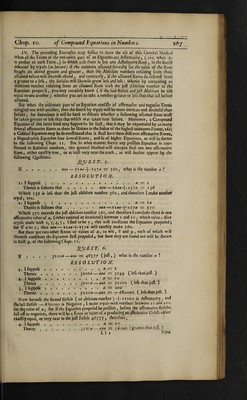
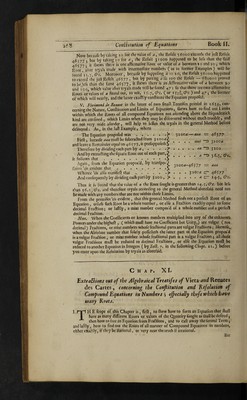
![C H A P. X, An Explication of ^imon StevinV General Ruley to ektraB one Root oat of any pojjible Equation in Numbers, either exaSilyy or very nearly true, 1. Quations falling under any of the Forms in the fourteenth and fifteenth Chapters Tv of the firrt Book of thefe Elements, are capable (as hath there been fliewn) of perfe^ft Refolutions in Numbers • viz,, the value of the Root or Roots fought in any of thofe Equations may be tound out and cxpreft exai^ly , either by feme Rational or Irrational number or numbers • but the perfe6f Refolution of all manner of Compound Equations in numbers , I have not found in any Author: and fince anExpofitioo of the General Method ot Fieta^ the Rules of HuMenifu and others to that purpofe, would make a large Treatife, and'after all leave the curious Analyft diUatisfied , 1 lliall not clogg thefe Elements with a tedious difeourfe upon thofe difficult Rules, which at the beft are exceeding tedious in Operation, and' feme of them uncertain too, but rather purfiie my firft Defign, which was to explain Fundamentals, and fuch Rules as are certain and moft important in this profound Art. However, I fliall lead the induftrious Learner a few flcps farther \ in order to his underftanding the Refolution of all manner of Compound Equations in numbers, and in this Chapter explain Simon Sievin's General Rule, which with the help of the Rules in the following eleventh Chapter, willdifcover all the Roots of any'poffible Equation in numbers, either exactly, if they be Rational-, or very nearly true if Irrational. XPEST. I. . If • • ^ ^ • aaap z6a — 40188, Vvhat is-the number 4 ? RESQLVTION, This Equation not falling under any of the three Forms in SeSl. \. Chaf. 15-. Book. i. cannot be refolvdti by any of the Canons in that Chapter, and therefore.according to Simon Sievin'% general Method 1 fearch out the number a by tryals, thus, viz. I. 1 fuppofe.. .. a — I Thence it follows that.* .. . . — i ^Vnd • . . . • i * . * . . . • • . 3154 —f y 2 B Therefore.. 444-]-2<54 — 'z-j . Which 27 ought to have been 401 88^ but it’*s too little- whereby I find that by fuppofing 4 to be 1,1 did not hit upon the true number 4, and therefore' f make anpthcr try al^ in like manner as before, viz, , 3. 1 fuppofe • 4 ,— 11 o Thence it follows that ......... 444 = '1000 And .... . . ........ -264 == z6o Therefore.’ ..' am-\-z6n 12^0 Which 1260 being yet too little, I make a third tfyal, viz. 5. I fuppofe . . .... 4 100 Thence it follows, that ... aaa~\~26a ~ loc526^q* Which 1002^00 exceeds the juft Refult or abfolute''nUmb'er 40188 in the latter part of the Equation firft: propos’d, and therefore the true number 4 is lefsthan 100; but the fecond tryal Ifiews it to be greater than 1 o, and therefore the whole nurhber which exprefl’etff the exairf, or at leaft part of the value of 4, rauft neceffarily confift of two Charafters, and confequently the firft (towards the left hand) muft be one of thefe'nine, 1, 2, 3, 4,5, 7,' 8, 9 - but becaufe by the fecond Inquiry 10 was found too little , I now make tryai with 2 tor the firft figure of the Root a , viz. 4. I fuppofe . ...... . ...... 4 2 0 .... Thence ..: 444^-264 — Sj’ao Which Refult 8520 being yet lefs than the juft Refult 40188, I make tryal again, viz. y. I fuppofe ..... . .. .. .. ..4 . 3 ® » Thence .... ..aaa-l^zda 27 7 So L 1 VVhiehi^](https://iiif.wellcomecollection.org/image/b30333726_0001_0285.jp2/full/800%2C/0/default.jpg)