Volume 1
The elements of that mathematical art commonly called algebra, expounded in four books / By John Kersey.
- John Kersey the elder
- Date:
- 1673
Licence: Public Domain Mark
Credit: The elements of that mathematical art commonly called algebra, expounded in four books / By John Kersey. Source: Wellcome Collection.
310/350 (page 290)
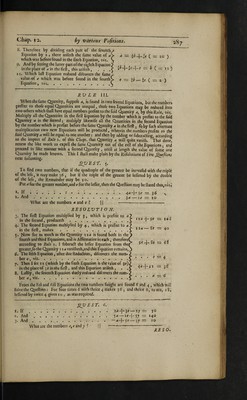
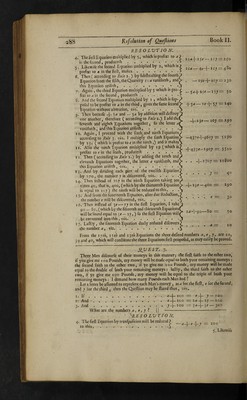
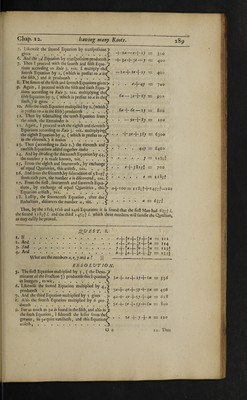
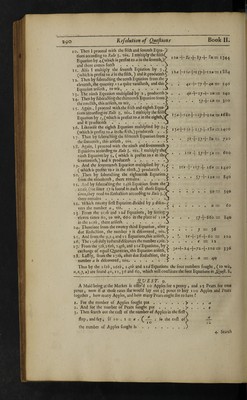
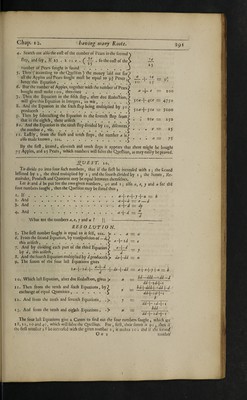
![I o. Then 1 proceed with the fifth and feventh Equa- tionsaccoiding to 3. vU. I tnnkiply thefifthi , j i ?»= 1344 Equation by 4,(which IS prefixt to ^ in the feventh,nr and there comes forth.3 IT. Alfo 1 multiply the feventh Equation by 3 ? ...u,,*-,884 (vvhichisprefixttOitinthefifth,) anditproducethf 1 1 53'1 4 12. Then by fubtrafting the tenth Equation from the - eleventh, the quantity 12 a quite vanilheth, and this Equation arifeth, to wit,. 13. The ninth Equation multiplied by 2 , produceth ^ 14. Then by fubtra£f ing the thirteenth Equation from 7 the twelfth, this arifeth, to wit,.-.J 15. Again, I proceed with the fifth and eighth Equa¬ tions according 3', I multiply the fifth Equation by j, (which is prefixt to a in the eighth,) and it produceth.. j6. Likewife the eighth Equation multiplied by 3, > (which is prefixt to in the fitth,) produceth . .5 17. Then by fubtraaing the fifteenth Equation from ? the fixteenth, this arifeth, viz.. . . . . .> 18. Again, I proceed with the ninth and feventeenth Equations according to Rule viz.. I multiply thei ninth Equation by ( which is prefixt to e in the feventeenthj) and it produceth '...... Ip. And the feventeenth Equation multiplied by 2,> ( which is prefixt to e in the ninth,) produceth . S 20. .Then by fubtraaing the eighteenth Equation^ from the nineteenth, there remains . . . . 5 21. And by fubtrafling the 14'f/; Equation from the zctlj] (for fince is found in each of thofe Equa- lions,they need no Reduflion according to Rule 3.) there remains .. 22. Which twenty firft Equation divided by p difco- ? ^ vers the number « , viz..j 23. From the zet/j and ziel Equations, by fetting eleven times 6g, to wit, 660 in the place of 1 lU in the icth , there arifeth.. _ 24. Therefore from the twenty third Equation, after ^ due Redu5fion, the number y is difeovered, viz.^ 25. And from the 9,24and 22 Equations,this arifeth, ^ . 26. The 25 r/j duly reduced difeovers the numbers,viz. . . . . — 17. Fromthe 5Tb.2«^,24r4,andiTJEquatim.s % .34+24 + 72-1-120= 336 exchange of equal Quantities, this Equation arifeth, ^ ^ i / i a a 28. Laftly, from the 27 after due Reduction, the ) • ♦ • • ^ J : ; 4e-H7;-4-4«= 540 . , 4e 27-I-— 240 • • • • 57-l-*2»= 300 I oe-l-i 07-]-! OH = 1680 154-J-i 8uz= 2400 . . 5 (? -j- 57 -|- 8« = 720 . . Joe -\~ 57-^ 5« 600 I ic'e -]- 107 1 Sff — 1440 . I . • '^y 840 • * • • • • -—- 5^^ H 60 . 57-[-($60 =2 r> H ^ . . y =2 ^6 2f-}--3^.-)-. (5o = e = 12 120 a 40 number a is difeovered, viz. Thus by the 28th, 26th ^ 24th and 22ii Equations the four numbers fought, (to wit, a, e,7,») are found 40,12,3 6 and <^o, which will conftitute the four Equations in J^uefi, 8. — ■ — —— ■ . ' ■ f ' ' - .1. ■ , , I X^EST. 9. A Maid being at the Market is offer’d i o Apples for a penny , and 2 5 Pears for two pence; now if at thofe rates flie would lay out p^ pence to buy 100 Apples and Pears together, how many Apples, and how many Pears ought (lie to have ? 1. For the number of Apples fought put . , . ', . . ^ , . , a 2. 'And for the number of Pears fought put . . . e 3. Then fearcb out the cofl: of the number of Apples in the firff' flepiandfay, If 10 . i :: 4 . (— ; fo the cofi: of^ ^10 the number of Apples fought is . , 4. Search a 1 o 1](https://iiif.wellcomecollection.org/image/b30333726_0001_0310.jp2/full/800%2C/0/default.jpg)