Volume 1
The elements of that mathematical art commonly called algebra, expounded in four books / By John Kersey.
- John Kersey the elder
- Date:
- 1673
Licence: Public Domain Mark
Credit: The elements of that mathematical art commonly called algebra, expounded in four books / By John Kersey. Source: Wellcome Collection.
322/350 (page 302)
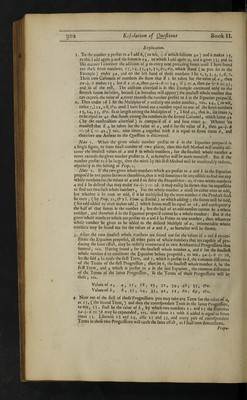
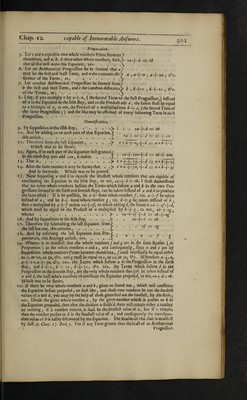
!['go2 Kefohition of Quejlions Book II. Explication. 1. To the number 9 prcfixt to a I add 6, (to wic, -j- 6 which follows ga ) and it makes i y, to this 1 add again 9 and the fumm is 2 4, to which I add again 9, and it gives 33; and in like manner 1 continue the addition of 9 to every next preceding fumrri until I have found out thefe feven numbers, 15’, “4? 5 *,60,59, which (land ( as you fee in the Example) under 94, and on the left hand of ihofe numbers J fet 1,2, 3,4, j,5,7.. Thefe two Colnmels of numbers do (hew that if i be taken for the value of a, then ga-\-6 makes 15; but if 2 = then 9^^-1- 5 — 24 ; if 3 = 4, then 94^]- 5 = 33. and fo of the reft. The addition aforefaid is in this Example continued only to the feventh fumm inclulive, becaufe (as hereafter will appear) the fmallefl: whole number that can exprefs the value of 4,never exceeds the number prefixt to b in the Equation propos’d. 2. Then under yb I fet the Multiples of 7 orderly one under another, viz., 14, (to wit, twice 7,) z 1,2 8, &c. until I have found out a number equal to one of the feven numbers I 5,24, 3 3, &c. fo at length among the Multiples of 7, 1 find 42, that is, fix times 7, to be equal to 42 that ftands,among the numbers in the fecond Columel, which latter ( by the conftruftion aforefaid ) is compos’d of 6 and four times 9. Whence ’tis inanifeft: that if 4 be taken for the value of 4, and 5 for the value of b, then 94 -J- 5 ~7^ ( — 42 .) viz. nine times 4 together with 6 is equal to feven times 5, and therefore one Anfwer to the Queftion is difeovered. Note T. When the given whole number prefixt to b in the Equation propos’d is a fingle figure, or fome fmall number of two places, then this firft Method will readily dif- cover thefmalleft values of a and b in whole numbers • for thefmalleft whole number a never exceeds the given number prefixt to as hereafter will be made manifeft; But if the number prefixt to b be large, then the work by this firft Method will be intollerabiy tedious, efpccially in the folving of Prop, 2. Note 2. Jf the two given whole numbers which are prefixt to 4 and b in the Equation propos’d be not prime between themfclves,then it will fometimes be impoftible to find out any whole numbers for. the values of 4 and b to folvc the Propofition: as, if two whole numbers 4 and b be defired that may make 543=2^, it may eafily be Ihewn that ’tis impoftible to find out two fuch whole numbers For the whole number 4 muft be either even or odd but whether it be even or odd, if it be multiplied by the even number 6 the Produift Ihali be even • ( by Prop. 21, 2 8. Elem. 9. Euclid.) to which adding 3 the fumm will be odd, (for odd added to even makes odd,) which fumm muft be equal to 2^, and confequently the half of that fumm is the number b . but the half of an odd number cannot be a whole number, and therefore b in the Equation propos’d cannot be a whole number: But if the given whole numbers which are prefixt to 4 and b be Prime to one another, then whatever whole number be given to be added to the defired Multiple of 4, innumerable whole numbers may be found out for the values of 4 and ^, as hereafter will be ftiewn. 3. After the two fmalleft whole numbers are found out for the values of 4 and b tocon- ftitute the Equation propofed, all other pairs of whole numbers that are capable of pro¬ ducing the fame effeft, may be orderly enumerated in two Arithmetical Progreftions thus formed j viz. Having found 4 for the fmalleft whole number 4, and 6 for the fmalleft whole number b to conftitutc the $lquation before jpropofed , to wit, 945 yb, let the faid 4 be made the firft Term, and 7, which is prefixt to b, the common difference of the Terms of the firft Progreftion . then let 5, the fmalleft wholenumber be the firft Terra, and 9 which is prefixt to 4 in the faid Equation , the common difference of the Terras of the latter Progreftion, fo the Terms of thofe Progreftions will be thefe, viz. ^ Valuesof4; 4, 11, 18, 25, 32, 39, 45, 53, &(:. Valuesofi^i 5, 15, 24, 33, 42, 51, 5o, 59, &c. 4. Now out of the firft of thofe Progreftions you may rake any Term for the value of 4 ■ as 11, (the fecond Term,) and then the correfpondent Term in the latter Progreftion] to wit, 15 , fliall be the value of ^ . by which two numbers 11 and ip the Equation 94*-j-* 6 — 7^ may be expounded, viz. nine times 11 with 5 added is equal to feven limes 15 Likewife 18 and 24, alfo 29 and 33, and every pair of correfpondent Terras in thofe two Progreftions will caufe the fame effect, as 1 lhall now deraonftrate, Prepa<-](https://iiif.wellcomecollection.org/image/b30333726_0001_0322.jp2/full/800%2C/0/default.jpg)