Volume 1
The elements of that mathematical art commonly called algebra, expounded in four books / By John Kersey.
- John Kersey the elder
- Date:
- 1673
Licence: Public Domain Mark
Credit: The elements of that mathematical art commonly called algebra, expounded in four books / By John Kersey. Source: Wellcome Collection.
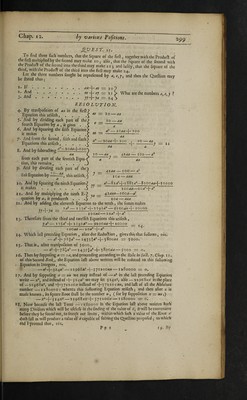
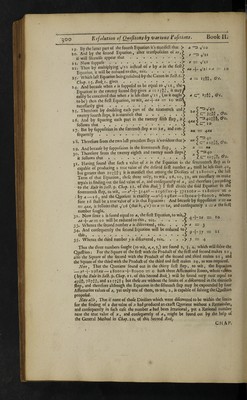
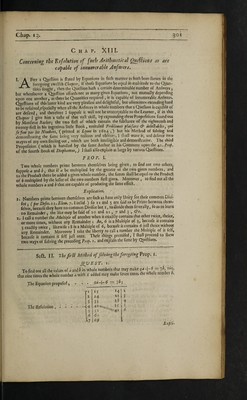
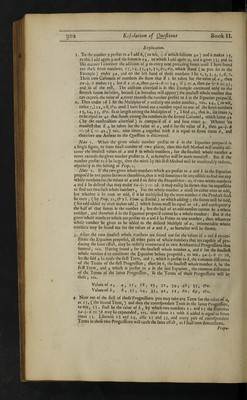
323/350 (page 303)
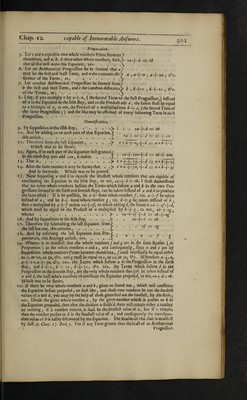
![■ca = fih a ) a-y^rt , a~[-2^ j (f'c. y , , &c* Preparation. f. Let c and n reprcfent two whole numbers Prime between'} themfelves, and <*, hy d three other whole numbers, fuch,S that all five will make this Equation, . . . .S 6), Let an Arithmetical Progrefiion be fo formed that a may be thefirftand leaft Term, and-« the common dif-J fcrence of the Terms, as, . * . . . . 7. Let another Arithmetical Progreflion be formed from b the firft and leaftTerm, andcthecomthondifference! of the Terms | as j . . . .. _ 8. I fay, if you multiply c by ^ + (thefecond Term of the firft Progreflion,) inftead of a in the Equation in the fifth ftep, and to the Produft add d y the fumm fliall be equal to a Multiple of «, to wit, the Produft of n multiplied into b c, (the fecond Term of the latter Progreflion ;) and the like may be affirmed of every following Terra in each Progreflion. ' . • Demonjiration, p. By fuppofirion in the fifth ftep . . )> 10. And by adding cn.to each part of that Equation,? , this arifeth, . . . . ^.S 11. Therefore from the laft Equation, ... . Which Was to be (hewn. 12. Again, if to each part of the Equation firft granted? .’Vi; CA Ca {“f d ; Cn'-\^'d ; nb nb *-{- cfi c y. ad zzz nr. b -j- c • J , era -|— ca'^-*icn'\-d rr «^<“j-2r« f-f- n X 2 c « X ^ jc c in the ninth ftep you add 2c«, it makes 13. That is. 14. After the fame manner it may be (hewn that . , )> c r a ^ny^[~ d And fo forwards. Which was to be proved. 1 y. Now fuppofing a and b to exprefs the fmalleft whole numbers that are capable of conftituting the Equation in the fifth ftep, to wit, ca>-{~d=. nb, I fhall demonftrate that no other whole numbers befides theTerms which follow a and b in the two Pro- greflions formed in the fixth and feventh fteps, can be taken inftead of a and b to produce the fame eft'eft; If it be poflible, let a-]- lome whole number /, viz. a -\-f be taken inftead of a- and let b^\- feme whole number viz. b-\-£ be taken inftead of b . then c multiplied by a-\-f makes ca^\^cfy to which adding dy the fumm is which muft be equal to the Product of n multiplied by b~-\~gy to wit, nb~\~n£^ ca M- cfArd ca~\-^d ~ nb nb cf — ng n f • g whence. 16. And by fuppofition in the fifth ftep, • . • . ^ 17. Therefore by fubtrading the laft Equation from 7 the laft but one, this remains,.^ 18. And by refolving the laft Equation into Pro-, portionals, this Analogy arifeth, viz,. 151. Whence it is raanifeft that the whole numbers/and are in the fame Reafon (or Proportion ) as the whole numbers n and c; and confequenily, lince n and c are by fuppofition whole numbers Prime between themlelves, / mull: neceflarily be equal either to n, or 2Ky or &c. and g muft be equal to c, or zc, or 3c, &c. Wherefore a ^ **1-2 «, 4 3«, &c. viz,, the Terms which follow a in the Pxogrelfion in the lixtli ftep, and b cy b -\- 2c , b^y^^Cy &c. viz., the Terms which follow b in the Progreflion in the feventh ftep, are the only whole numbers that can be taken inftead of a and the leaft whole numbers to conftitute the Equation propofed, iomtyCa-\-d—nb. Which was to be ftiewn. 20. If there be two whole numbers a and by given or found out, which will conftitute the Equation before propofed, or fuch like, and ihofe two numbers be not the fmalleft values of a and by you may by the help of thofe given find out the fmalleft, by this Rule - viz.. Divide the given whole number a , by the given number which is prefixt to b in thcTquation propofed, then after the divifion is finifli’d there will remain either a number or nothing . if a number remain, it lhall be the fmalleft value of a, but if o remain, then the number prefixt to b is the fmalleft value of 4, and confcquently the correfpon- dent value of ^ is eafily difeovered by the Equation. The Reafon of this Pule is nDanifeft by Se^. Chap, 17. Book^i. For if any Terra greater than ihc.leaft of an Arithmetical .j . Progreflion](https://iiif.wellcomecollection.org/image/b30333726_0001_0323.jp2/full/800%2C/0/default.jpg)