Volume 1
The elements of that mathematical art commonly called algebra, expounded in four books / By John Kersey.
- John Kersey the elder
- Date:
- 1673
Licence: Public Domain Mark
Credit: The elements of that mathematical art commonly called algebra, expounded in four books / By John Kersey. Source: Wellcome Collection.
333/350 (page 313)
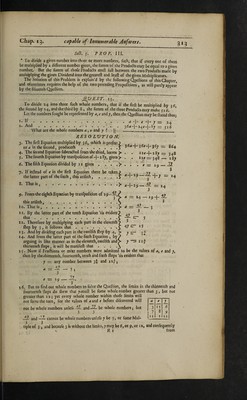
![. . Chap. 13, capable of Innumerable Anfwers. 3M SeU. Pi? OP. HI. • To divide a given number into three or more numbers, fuch, that if every dne of them be multiplied by a different number given, the furam of the Products may be equal to a given number. But the fumra of thofe Produds muft fall between the two Produfts made by multiplying the given Dividend into the greateft and lead of the given Multiplicators. The Solution of this Problem is explain’d by the following Queftions of this Chapter, ’and oftentimes requires the help of the two preceding Propofitions, as will partly appear by the fifteenth Quefiion. • Xl^EST, 13. To divide 24 into three fuch whole numbers, that if the firft be multiplied by 35; the fecond by 24, and the third by 8 , the fumra of the three Produds may make yi <5. Let the numbers fought be reprefented by e and then the Queftion may be dated thus; ,.' * * • • '• • a e -h y = 24 2’* And.V .. . 364-]-8t r= yi5 ^yhat arc the whole numbers a, e and y t - | | ______ RES O LVTIO N, - ^ 3. The firft Equation multiplied by 3d, which is prefixt) to in the fecond, produceth . . ... . ,3 3^7 = ^^4 4. The fecond Equation fubtraded from the third, leaves ^ . . i2«-j-2 8v = 348 y. ThefourthEquationby tranfpofitionof+28^, givesj>‘. . i2e=«348. 287 6, The fifth Equation divided by iz gives . . T ^ e = ^9 7. If inftead of e in the firft Equation there be taken ^ the latter part of the fixth, this arifeth, . . 21 3 8. That is, A -]-■ 2p —. -^1 ~ 24 3 A — 24 2p “4~* 3 2 ^ By the latter part of the tenth Equation tis evident? iQr ' _ C —lE r~ p. From the eighth Equation by tranfpofition of this arifeth, . . . . • . • ^ . 10. 'That ts, . . . . . d . . d m . . .- - ^ that . .'.J 12. Therefore by multiplying each part in the eleventh? ftep by 3, it follows that, . 13. And by dividing each part in the twelfth ftep by 4, > 14. And from the latter part of the fixth Equation j./by. arguing in like manner as in the eleventh, twelfth and^ thirteenth fteps, it will be manifeft that _ ly. Now if Fraftions or mixt numbers were admitted to be the values of^, t and /, then by the,thirteenth, fourteenth, tenth and fixth fteps ’tis evident that y = any number between 3^ and ii^j 3 77 e r= 2 9 —• —-v, % 3 16. But to find out whole numbers to folvc the Queftion, the limits in the thirteenth and fourteenth fteps do fliew that ;.muft be fome whole number greater than 3, but not greater than 12; yet every whole number within thofe limits will 5 not ferve the turn, for the values of a and e before difeovered will not be whole numbers unlefs and-^ be whole numbers j but 3 3 21 and -2. cannot be whole numbers unlefs 7 be 3, or fome Mul- 3 3 tiple of 3 j and becaufe 3 is without the limits, 7 may be 5, or p, or 12, and confequcntly V R r from a y 3 15 6 7 8 9](https://iiif.wellcomecollection.org/image/b30333726_0001_0333.jp2/full/800%2C/0/default.jpg)