Volume 1
The elements of that mathematical art commonly called algebra, expounded in four books / By John Kersey.
- John Kersey the elder
- Date:
- 1673
Licence: Public Domain Mark
Credit: The elements of that mathematical art commonly called algebra, expounded in four books / By John Kersey. Source: Wellcome Collection.
342/350 (page 322)
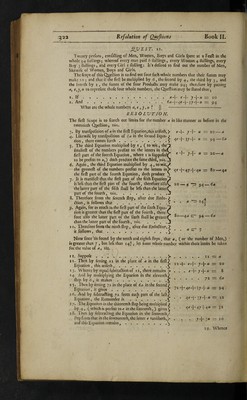
![ft — 20 4 U — -- 54 ^V£ST. z2. Twenty perfons, confiding of Men, Women, Boj’s and Girls fpent at a Feaft in the whole 94 Ihillings; whereof every man paid 6 {hillings, every Woman 4 llhllings, every Boy 3 (liillings, and every Girl i fliiiJing: It’s defired to find out the number of Men, likewife of Women, Boys and Girls. The fcope of this Quellion is to find out four fuch whole numbers that their fumm may make ; and that if the firft be multiplied by 6, the fecond by 4, the third by 3 , and the fourth by i, the fumm of the four Produfts may make 94; therefore by putting а, e,], u. to reprefent thofe four whole numbers, the Quedion may be dated thus‘j r. If...4-1- ^-J-4 — 20 2. And.'.;« =: 94 What are the whole numbers 4, e , ? [| ^-----^-- RBSOLVTION. The fird Scope is to fearch out limits for the number 4 in like manner as before in the twentieth Quedion> viz. 3. By tranfpofition of 4 in the fird Equation,this arifeth, e *-|- y -\- 4. Likewife by tranfpofition of 6a in the fecond Equa- ^ , . tion , there comes forth.^ y. The third Equation multiplied by i, (to wit, the' fraalled of the numbers prefixt to. the letters in the( fird part of the fourth Equation , where i is fuppofed( to be prefixt to »,) doth produce the fame third, viz.. б. Again, the third Equation multiplied by 4, to wir,^ - the greateft of the numbers prefixt to the letters inS ^e-l-'47-|-4» = 80 — 44 the fird part of the fourth Equation, doth produce j 7. It is raanifed that the fird part of the fifth Equation^ is lefs than the fird part of the fourth, therefore alfoC 20 — 4 -p ^4_6a the latter part of the fifth fhalJ be Icfs than the latter^ ‘ ' part of the fourth, viz. ....... 8. Therefore from the feventh dep, after due Redu- ? ilion , it follows that ..S 9. Again, for as much as the fird part of the fixth Equa¬ tion is greater than the fird part of the fourth, there-^ fore alfo the latter part of the fixth fliall be greater( than the latter part of the fourth, viz. I o. Therefore from the ninth dep, after due Rcdn£lion, it follows, that ... Now fince’tisfound by the tenth and eighth deps, that 4, (or the number of Men,) is greater than 7 , but lefs than 14^, let fome whole number within thofe limits be taken for the value of a, viz. e -h 7+ » = 20 — a 4 14 5 80—44 CT 94 — 6a a cr 7 11. Suppofe . y.J> . 12. Then by fetting 12 in the place of a in the fird^ Equation , this arifeth,.^ * 13. Whence by equal fubtradion of 12, there remains . 14. And by multiplying the Equation in the eleventh) dep by 6, it makes.^ * 16. And by fubtrafting 72 from each part of the lad? Equation, the Remainder is . .£ 17. The Equation in the thirteenth dep being multiplied / by 4, ( which is prefixt to e in the fixteenth,) gives ^ 18. Then by fubtra<ding the Equation in the fixteenth^ dep from that in the feventeenth, the letter e vanillicth, > and this Equation remains..^ 12 ■= 4 20 i . e -1- = 8 • • . . 72 = 6a 3) “I' = 94 . 4e -1-374.4 — 2Z • -1-474^4 = 32 • • 11 + 10 19. Whence V / i](https://iiif.wellcomecollection.org/image/b30333726_0001_0342.jp2/full/800%2C/0/default.jpg)