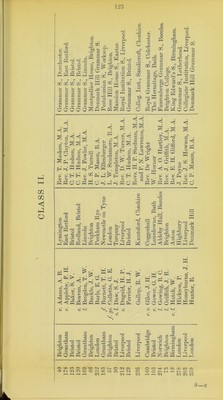
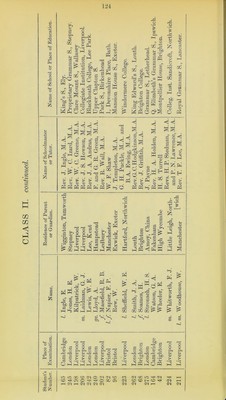
Examination of students who are not members of the University : examination papers, class lists, &c. for the examination held in December 1858 : to which are added the regulations for the examination in 1859 / University of Cambridge.
- University of Cambridge
- Date:
- 1859
Licence: Public Domain Mark
Credit: Examination of students who are not members of the University : examination papers, class lists, &c. for the examination held in December 1858 : to which are added the regulations for the examination in 1859 / University of Cambridge. Source: Wellcome Collection.
Provider: This material has been provided by The Royal College of Surgeons of England. The original may be consulted at The Royal College of Surgeons of England.
128/156 (page 120)
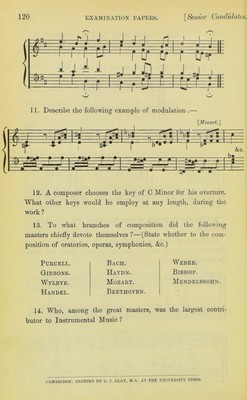
![I a £ ii ZH— * » — • 9 r—* 8 •1 1—„ m ® - ]=M- ■—i—!■— L_y=d « 1 U 11. Describe the following example of modulation .— / [Mozart. ] -i—i - tt* -i niti -^8 =^rj « j»~| s—^ r-rw-f-f f—w*-* :^===^i=F=F L * i.*“ —• - ,• y= &c. ba -=t— ♦— ♦ r L*_—*—*- •tTZZ 12. A composer chooses the key of C Minor for his overture. What other keys would he employ at any length, during the work ? 13. To what branches of composition did the following masters chiefly devote themselves ?—(State whether to the com- position of oratorios, operas, symphonies, &c.) Purcell. Gibbons. Wylbye. Handel. Bach. Haydn. Mozart. Beethoven. Weber. Bishop. Mendelssohn. 14. Who, among the great masters, was the largest contri- butor to Instrumental Music ? CAMBRIDGE: PRINTED BY C. J. CLAY, M.A. AT THE UNIVERSITY PRESS.](https://iiif.wellcomecollection.org/image/b22440355_0130.jp2/full/800%2C/0/default.jpg)