Examination of students who are not members of the University : examination papers, class lists, &c. for the examination held in December 1858 : to which are added the regulations for the examination in 1859 / University of Cambridge.
- University of Cambridge
- Date:
- 1859
Licence: Public Domain Mark
Credit: Examination of students who are not members of the University : examination papers, class lists, &c. for the examination held in December 1858 : to which are added the regulations for the examination in 1859 / University of Cambridge. Source: Wellcome Collection.
Provider: This material has been provided by The Royal College of Surgeons of England. The original may be consulted at The Royal College of Surgeons of England.
86/156 (page 78)
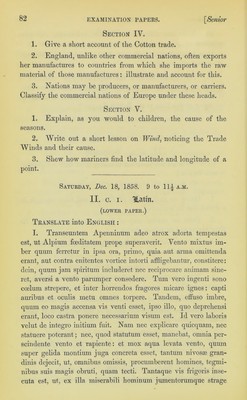
![Section V. 1. Give the words, if you can,—if not, the substance of Brutus’ answer when Cassius asks him what he is determined to do if they lose the Battle of Philippi. 2. Point out some of the excellences of Shakespeare’s treat- ment of the quarrel between Brutus and Cassius, in the fourth Act. 3. Analyse the train of thought in the following soliloquy of Cassius in the first Act: “Well, Brutus, thou art noble; yet, I see, Thy honourable metal may be wrought From that it is disposed: therefore it is meet That noble minds keep ever with their likes: For who so firm that cannot be seduced ? Caesar doth bear me hard; but he loves Brutus: If I were Brutus now, and he were Cassius, He should not humour me.” Section VI. 1. Contrast the characters of Brutus and of Cassius. With what other characters in Shakespeare’s plays may they respec- tively be compared? 2. Compare Shakespeare’s Julius Caesar with any other historical drama that you may have read. 3. It has been said that dramatic poetry is founded on the relation of Providence to the human will. Explain the saying, illustrating it from this or any other of Shakespeare’s plays. Monday, Dec. 20, 1858. 6 to 8| p.m. II. b. 3. political latonomg. [N.B. Candidates are at liberty to confine themselves to one of the two subjects in this Paper, or to answer questions in both.] 1. What is meant by Political Economy? What prin- ciples besides those of Political Economy must be considered in a treatise on Politics? Are the laws of Political Economy universally true ?](https://iiif.wellcomecollection.org/image/b22440355_0088.jp2/full/800%2C/0/default.jpg)