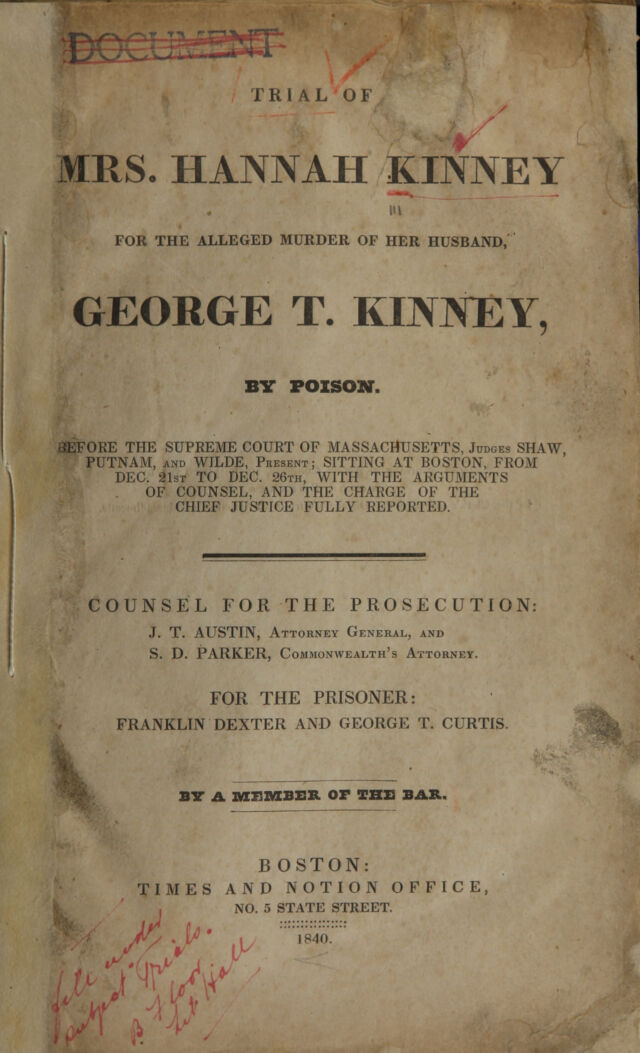
Trial of Mrs. Hannah Kinney for the alleged murder of her husband, George T. Kinney, by poison : before the Supreme Court of Massachusetts, Judges Shaw, Putnam, and Wilde, present : sitting at Boston, from Dec. 21st to Dec. 26th, with the arguments of counsel, and the charge of the chief justice fully reported : counsel for the prosecution, J.T. Austin, attorney general, and S.D. Parker, commonwealth's attorney : for the prisoner, Franklin Dexter and George T. Curtis / by a member of the bar.
- Kinney, Hannah
- Date:
- 1840
Licence: Public Domain Mark
Credit: Trial of Mrs. Hannah Kinney for the alleged murder of her husband, George T. Kinney, by poison : before the Supreme Court of Massachusetts, Judges Shaw, Putnam, and Wilde, present : sitting at Boston, from Dec. 21st to Dec. 26th, with the arguments of counsel, and the charge of the chief justice fully reported : counsel for the prosecution, J.T. Austin, attorney general, and S.D. Parker, commonwealth's attorney : for the prisoner, Franklin Dexter and George T. Curtis / by a member of the bar. Source: Wellcome Collection.
Provider: This material has been provided by the National Library of Medicine (U.S.), through the Medical Heritage Library. The original may be consulted at the National Library of Medicine (U.S.)
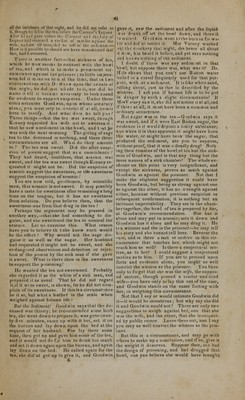
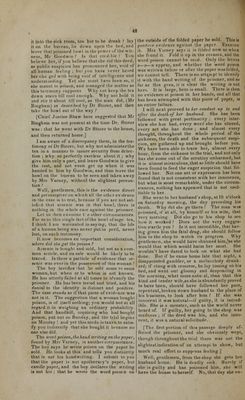
![city. I'll »re his'von a change in his reneral habits, since he came to this city. He loft me in 182k and went to sen; I next saw him in 18 56, in this city. Hive seen him since his mimage to Mrs Kinuey and heard him spsak of her iif ths highest terms; never otherwise.— His character formerly was cheerful; when I saw him here he wa-. eh uige I, which I attributed to his embar- rassments He was different in many respects. When with me be seldom took ardent spirits, bnl when I saw him in this city he drank more. The effect upon him Was to make him gloomy. I saw him at the Tremont Theatre one evening ; he went in affected with liq lor, and >lept through the first act; soon after said h ■ believ- ed he wool I g> aivav. and left me. Tliis was between the 5th and 10th of October 183J; I did not see him again. Cross Examined. When I saw him in 1839, he was much depressed. It was a general time of embarrass- ment in b isiness Do not know that he was more de- pressed th in many persons in business were. In 1838 I was in the city tour days; saw him one of those days; in 1836 saw him in January. April, and July; I was here on business; did not see him from 1838 till Oct. L839; witness desires to correct the dates; first saw him in Dec. 1836, and then in 1838; I change it from '38 to January and October 1839; yes, sir; I am correct; in January, April, Jjjly and October of 1831), I saw him, anil have not seen him since. Ques. How came you a witness ? \u-. I u,i> conversing with a gentleman in North- ampton, of my connexion wiih Mr Kinney, and he wrote to the conn-el here. I did not desire him to, and did not state it \\ i111 the expectation of coming here.— He said my testimony would be important, but I told him my business did not require me to go there. The conversation was caused by what the gentleman who wrote the letter read in the Morning Post. When I saw him in this city, I Saw him play cards for money, a small amount. I played, but did not stake any thing. I played for Kinney, and won about eight shillings lor him. 1 believe. ITs result was a gain. Cannot tell the name of the game I played. Never saw it before nor since. In Chief. Mr Kinney had a peculiar determination to carry a point that he was bent upon. Generally quick ii* making up his mind ; I saw :Mr Kinney at Philadelphia, alter 1 saw him in 1836 ; I think it must have been in 1837. The testimony here closed on both sides, and Mr. Dexter began his argument at It) minutes before 10. and closed at -J minutes after 1, (three hours and a half)— The ability, clearness and convincing three of this ar- gument, as well as the beauty and inipressiveness of man} of its passages, were acknowledged by the intent and untiring attention of the crowd who listened to it. We shall give it at (nil length, which will be the only • elaborate report attempted. ARGUMENT OF FRANKLIN DEXTER FOR THE DEFENCE. Fkidav Morning, Dec. 25. [Mr. Dexter began his argument in the close of the defence, at 10 minutes to 10, and closed 25 minutes after one.] Gentlemen of the Jury— I am now to speak to you the last words of the pri- soner at the bar. before you pass on her deliverance or deaih; and little as I may apprehend the result of your deliberation, it is impossible I should approach the task without great emotion. It is not any difficulty or doubt in the cause, but die mere possibility of a monstrous in- justice being done, which lies with an oppressive Weight' upon me. the accidents that attend all hum in deliberations, and I cannot divest myself of all appreleasioa oi tiie awful consequences of amtstak i ofth • Jury. Hut slight as are my fears an I hide a. shj in ly seem to have been oppresse I durin' the lrial,yo i, gt i le.riju, can know nothing Of the terrible effort re (uire I to win I up her miftd to this calm en I iraucB \ 0 i led Ii it o ilv as she' appears here, surroui te I by all lli • circa,n it tares ol'a public trial; and bearing it with a diguity, pro- priety and perfect composure that ought to bean as- ' surance of her innocence. But you have not seen h sr in her secret hours of andety to be delivered uat from the punishment of the law—or that she cau.iot serious* ly fear ; but from a dreadful weigh; of public suspicion and odium. But this is not all ; no m liter what her confidence may be in the result, thers are loiHy hours that must terribly oppress her. She has looked through this trial and seen the prospect not only of deliverance from the law b\ your acquittal, but of a vindication in public opinion. But, gentlemen, she is human and a woman ; and there must have been moments of a dark- er hue, when the possibility of an adverse judgement has overshadowed her mind. That most horrible spec- tacle of the execution of a human being, must more than once, have flitted across her aching vision. In the sileul darkness of her cell, she must, at tunes, have *een the most horrible phantom that can scare the sick nun on his pillow, and even in dreams indict upin us the last agony of the human heart. But these are visions of the imagination, When we look deliberately at the cause, it is impossible that she or I should fear tor the result. One remark, by way of caution, I will make. It is this—It is difficult lor you to resist the power of a pre- conceived suspicion ; I do noi mean in your own, but in the whole public mind. The prisoner comes before you loaded with suspicion, and you seem to sit here to try, not whether she is guilty, but whether she can clear herself of the cloud ol suspicion thrown upon her. Vou and everyone, look at her, unconsciously, as a person who is to prove her innocence, and every fact that does not prove her innocence, seems, by preconceived sus- picion, to tend to confirm her guilt. It is the constitution of the human mind thus lo be imperceptibly influenced, and when thus predisposed lo receive impressions, trifles light as air, become confirmation strong. In fact, though not in law, the prisoner, by reason of these suspicions, is not on trial whether she be guilty, but is put to the bar to prove her innocenee. Resist these inlluences. I beseech vou gentlemen.— Remember you are not to try the truth of public suspi- cion, but the truth of the fact as if she had never been charged before. Vou are to begin at the beginning, and try her. as if innocent and unsuspected : and if your judgments stop short of conviction of certain guilt, vou are bound to acquit. Before you can touch the lire of die prisoner, you must have a firm, unwavering con- viction that here was a death by design, and thai the person who committed it is the prisoner and no other. This is a case of circumstantial evidence, and only of circumstantial evidence. Vou are therefore to be sat isfied that the prisoner did die act. only by being satis- fied that no other could have done it. Vou must also be satisfied beyond all reasonable doubt that it is impos- sible to explain the evidence without inferring her guilt —that the evidence not only shows her guilt but ex- cludes that of all others, The fust enquiry is. did the man die of poison ? I think you will have little doubt of that, but still there is great delect in the proof. I do not however, rely on that; there is strength enough behind itj but if there were not, there is such difficulty here, in the outset of the case, that you would pause long before you would sa\ this proof satisfies vou that the death was caused by poison. There should have been proof be}ond all ques- tion, that the poison, said lo have been found iu the](https://iiif.wellcomecollection.org/image/b21134765_0038.jp2/full/800%2C/0/default.jpg)
 No text description is available for this image
 No text description is available for this image
 No text description is available for this image