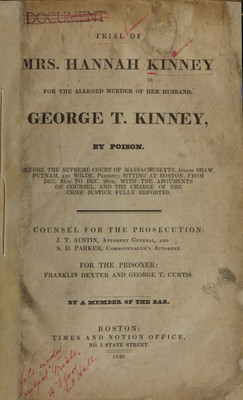
Trial of Mrs. Hannah Kinney for the alleged murder of her husband, George T. Kinney, by poison : before the Supreme Court of Massachusetts, Judges Shaw, Putnam, and Wilde, present : sitting at Boston, from Dec. 21st to Dec. 26th, with the arguments of counsel, and the charge of the chief justice fully reported : counsel for the prosecution, J.T. Austin, attorney general, and S.D. Parker, commonwealth's attorney : for the prisoner, Franklin Dexter and George T. Curtis / by a member of the bar.
- Kinney, Hannah
- Date:
- 1840
Licence: Public Domain Mark
Credit: Trial of Mrs. Hannah Kinney for the alleged murder of her husband, George T. Kinney, by poison : before the Supreme Court of Massachusetts, Judges Shaw, Putnam, and Wilde, present : sitting at Boston, from Dec. 21st to Dec. 26th, with the arguments of counsel, and the charge of the chief justice fully reported : counsel for the prosecution, J.T. Austin, attorney general, and S.D. Parker, commonwealth's attorney : for the prisoner, Franklin Dexter and George T. Curtis / by a member of the bar. Source: Wellcome Collection.
Provider: This material has been provided by the National Library of Medicine (U.S.), through the Medical Heritage Library. The original may be consulted at the National Library of Medicine (U.S.)
![40 minutes. The Chiei Justice said that it must not be understood that the Court had pas- sed upon all the answers of the Jurors. Several of the answers were of a doubtful character, but as there was a sufficient number of Jurors with- out these, they were passed. The Clerk read the indictment, charging the prisoner with poisoning her husband, George T Kinney, in August last with malice afore- thought, by mixing arsenic in drink prepared for said George, with intent to murder him. The indictment set forth that the arsenic was mixed in herb tea prepared for the deceased, who was sick, which he drank on the 9th of August, and died on the 15th. [The death ac- tually took place on the 9th. The indictment alleged the farthest day, from matter of form.] The Jurors were then called, as enipanr.elled, consisting of— Abraham W. Blanchard, Foreman, (appointed by the Court) Charles Arnold, James M. Bar- nard, Sewell Barker, Geo. W. Bazin, James Blake, Charles Brown, Franklin F. Blood, Fran- cis Codman, Josiah W. Daniel, Nathaniel G. Elliot, Elislia Faxon. Samuel D. Parker, Esq. Attorney of the Commonwealth, for Suffolk, then opened thte case for the Government. Gentlemen of the Jury:— The Attorney General has requested me on this solemn occasion to give hiin such assistance as I may be able to do, in the discharge of those appropriate duties required by law in capital cases, particularly of its highest officer ; duties, the most important and painful that can be as- signed to any one in judicial tribunals. No man can be engaged in more affecting or appalling of- ficial acts, than in commencing, pursuing and pressing investigations, in which the ultimate safety of all men is involved, and which are es- pecially designed to terminate, as in this case, in the deliverance or destruction of a human being, placed in jeopardy under the most distressing accusation. The utmost care and caution in such proceedings are enjoined by the rules of law; and every measure, suggested by the strictest regard lor justice, and the most laudable love of mercy, is taken, to remove prejudice, to preserve impartiality, and to secure the attainment of truth. In this interesting and awful business we are now here engaged; and I hope that all who are to take part in this most serious trial,— counsel, witnesses, judges and jurors,—mav conscientiously feel the weight of that great re- sponsibility, which, without our seeking, has been cast upon all of us at this time, and in this place, by the laws of our country. It is my very unpleasant, yet my official task, under the request I have mentioned, to open this important and interesting case before the hon- orable Court who here preside over our proceed-' ings, and before you, gentlemen, who are now \ engaged by the solemn sanctions of your oaths . and the obligations of conscience, in the sight of God and of your fellow citizens, to do justice j and right between the Commonwealth and the , unhappy prisoner you have in charge. It is not,' on my part, any affectation of sensibility to de- clare, that I feel oppressed, not only by the awful consequences to which this trial may lead, but by the numerous difficulties in it which are to be surmounted ; difficulties now very com- mon in all capital cases in the present agitated state of public opinion in relation to the punish- ment by death ;—difficulties, much increased, when the atrocious crime imputed to the prison- er is alleged to have been committed by that subtle and generally invisible but most tremen dous agent, the most detested of all means of homicide, secret Poiso.N : difficulties, whieh also become yet more formidable, when the horrible charge is made against a woman, usually the most amiable and innocent part of human nature. Whenever in any case, the life of a human being, the gift of God, and one of the most precious of his grants, is by the laws of the land demand- ed as the forfeit of an act alleged to have been done in violation of law, the minds of men, be- fore they allow the highest punishment to be exacted, require what, in the acknowledged ob- scurity which usually covers personal motives and conceals criminal actions, cannot always be obtained, unequivocal proof, which excludes all reasonable doubt of that particular act having been done, by the party accused. The terrible consequences of a possible mis- take in making up a judgment from human testimony, and circumstantial evidence, have often inclined jurors in capital cases to acquit, when, as reasonable men out of court, acting upon the common presumption and faith which govern mankind in ordinary occurrences of life, they believed the accused to be guilty, and would have returned a corresponding verdict in the trial, if the punishment which was to follow such verdict were less fatal. In the course of centuries, it is supposed a few such lamentable mistakes have been made by juries; and the records of them with all their appalling consequences are usually cited by prisoners' counsel in cases depending on cir- cumstantial testimony: and yet the evidence of those fatal results being unjust has sometimes rested on no better foundation, than the wholly uncorroborated and often suspicious confession of some hardened and convicted felon at the gallows, who disregarded truth all his life time, and would not have been received as a compe- tent witness concerning the most trifling matter in any court of judicature. But the danger of such painful errors has long since passed away, for so tender in cases of homicide have modern tribunals grown, and es- pecially in this country, that juries are now strongly impressed with lively sympathies for the living and interesting beings who stand trembling before them, for relief or for deeper woe; and are so much alarmed by the loud and solemn predictions of the awful and irreparable 'consequences of an unfavorable error of judg- ment, that they at the present day are apt to seek, not so eagerly for indications of guilt, as for reasons of acquittal, by which they may escape the upbraidings of their conscience, while they yield to the grateful feelings of compassion.](https://iiif.wellcomecollection.org/image/b21134765_0004.jp2/full/800%2C/0/default.jpg)