Licence: Public Domain Mark
Credit: A manual of pathological anatomy (Volume 1-2). Source: Wellcome Collection.
Provider: This material has been provided by the National Library of Medicine (U.S.), through the Medical Heritage Library. The original may be consulted at the National Library of Medicine (U.S.)
30/614
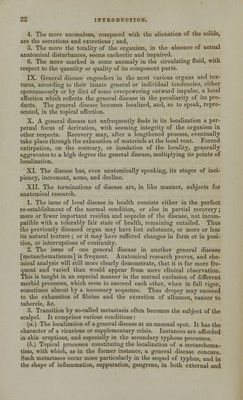
![4. The more anomalous, compared with the alienation of the solids, are the secretions and excretions ; and, 5. The more the totality of the organism, in the absence of actual anatomical disturbances, seems cachectic and impaired. 6. The more marked is some anomaly in the circulating fluid, with respect to the quantity or quality of its component parts. IX. General disease engenders in the most various organs and tex- tures, according to their innate general or individual tendencies, either spontaneously or by dint of some overpowering outward impulse, a local affection which reflects the general disease in the peculiarity of its pro- ducts. The general disease becomes localized, and, so to speak, repre- sented, in the topical affection. X. A general disease not unfrequently finds in its localization a per- petual focus of derivation, with seeming integrity of the organism in other respects. Recovery may, after a lengthened process, eventually take place through the exhaustion of materials at the local vent. Forced extirpation, on the contrary, or insulation of the locality, generally aggravates to a high degree the general disease, multiplying its points of localization. XI. The disease has, even anatomically speaking, its stages of inci- piency, increment, acme, and decline. XII. The terminations of disease are, in like manner, subjects for anatomical research. 1. The issue of local disease in health consists either in the perfect re-establishment of the normal condition, or else in partial recovery; more or fewer important residua and sequelae of the disease, not incom- patible with a tolerably fair state of health, remaining entailed. Thus the previously diseased organ may have lost substance, or more or less its natural texture ; or it may have suffered changes in form or in posi- tion, or interruptions of continuity. 2. The issue of one general disease in another general disease [metaschematismus] is frequent. Anatomical research proves, and che- mical analysis will still more clearly demonstrate, that it is far more fre- quent and varied than would appear from mere clinical observation. This is taught in an especial manner in the mutual exclusion of different morbid processes, which seem to succeed each other, when in full vigor, sometimes almost by a necessary sequence. Thus dropsy may succeed to the exhaustion of fibrine and the excretion of albumen, cancer to tubercle, &c. 3. Transition by so-called metastasis often becomes the subject of the scalpel. It comprises various conditions: (a.) The localization of a general disease at an unusual spot. It has the character of a vicarious or supplementary crisis. Instances are afforded in skin eruptions, and especially in the secondary typhous processes. (b.) Topical processes constituting the localization of a metaschema- tism, with which, as in the former instance, a general disease concurs. Such metastases occur more particularly in the sequel of typhus, and in the shape of inflammation, suppuration, gangrene, in both external and](https://iiif.wellcomecollection.org/image/b2115109x_0030.jp2/full/800%2C/0/default.jpg)

 No text description is available for this image
 No text description is available for this image
 No text description is available for this image