Licence: Public Domain Mark
Credit: A manual of pathological anatomy (Volume 1-2). Source: Wellcome Collection.
Provider: This material has been provided by the National Library of Medicine (U.S.), through the Medical Heritage Library. The original may be consulted at the National Library of Medicine (U.S.)
34/614
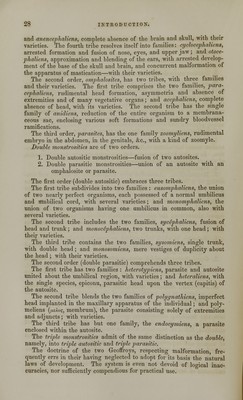
![tinction of hermaphroditism from other malformations constitutes the great defect of Meckel's classification. Breschet has, in his classification, hroken up Buffon's first class into two, by separating duplicate formations from malformations per exces- sum. The four orders of his classification are : 1, ageneses, devious for- mations with diminution of plastic power; 2, hypergeneses, with aug- mentation of plastic power; 3, diplogeneses, devious formations with the fusion of germs—duplicate formations; 4, heterogeneses, with alien cha- racter of the product of generation. The further division is as follows : The first order, ageneses, breaks up into four species, (a.) Agenesie, absence—defective development. It is either partial, as in hemicephalie, aprosopie, acephalie, apleurie; or it is gene- ral, as in microsomatie (dwarfishness, cretinism). (b.) Diastematie, cleft formation at the median line. It is subdivided according as it affects the head or the trunk, into diastemence- phalie, &c, and diastematosternie, &c. (c.) Atresie. (d.) Symphysie, coalition fusion. The second order, hypergenese, presents two species, according as in- dividual parts or the entire body are concerned. To the former species belong macrocephalie, macroprosopie, &c.; the latter consists of macro- somatie (giant growth). The third order, diplogenese, is divisible into external, through fusion or adhesion, as in diplocephalie, diplothoracie; and internal, through penetration (per penetrationem). The fourth order has three species. (a.) Deviation as to site, either of the entire organism [extra-uterine pregnancy] or of individual organs [ectopie]. (b.) Deviation as to number, polypsedie—the coexistence in the uterus of several foetuses. (c.) Deviation as to color—leucopathie, cyanopathie, cirrhopathie. In this arrangement, the distinction of dip-ogenesis from hypergenesis is based upon the unproved doctrine of the fusion of two germs constitut- ing duplicate formation. To the order, heterogenesis, are referred devi- ations which ought not to be designated as malformations. One of the best known classifications of late years is that of the two Geoffroy St. Hilaires, father and son, who handle malformations, accord- ing to the natural method, under the term teratology (from repaq, mon- strum). Malformations are simple and complex—anomalies simples et com- plexes. The simple—he*mite*ries—are either so-called variations, lusus naturae, where the anomaly is slight, causing neither disturbance of function nor deformity, or else defects of conformation, malformations in a restricted sense, where, however trifling the anatomical deviation, they impede or preclude the exercise of one or more functions, or occasion deformity. They are divided into five classes, the anomaly being respectively con- cerned with—](https://iiif.wellcomecollection.org/image/b2115109x_0034.jp2/full/800%2C/0/default.jpg)

 No text description is available for this image
 No text description is available for this image
 No text description is available for this image