Age and length of service as affecting the sickness and mortality of the European army : and aggregate of the statistics of the army for the ten-year period, 1860-69 / by James L Bryden.
- James Bryden
- Date:
- 1874
Licence: Public Domain Mark
Credit: Age and length of service as affecting the sickness and mortality of the European army : and aggregate of the statistics of the army for the ten-year period, 1860-69 / by James L Bryden. Source: Wellcome Collection.
Provider: This material has been provided by Royal College of Physicians, London. The original may be consulted at Royal College of Physicians, London.
23/82 page 9
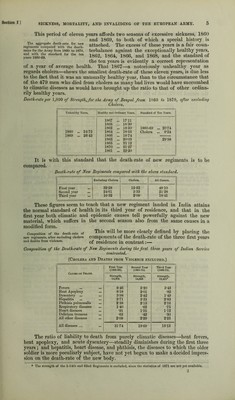
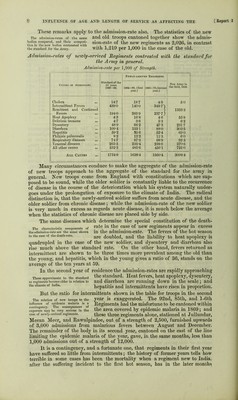
![chanced to be included in a provincial area suffering universally from an epochal visitation of malarious fever. An example of this occurring in the period under consideration, was that of tlie 21st Fusiliers, at Kurrachee, in 1869. Standing as the figures do in the preceding table, the comparative exclusion The fevers from which new regiments ^f the element of malarious fevei’s is of advantage, suffer are, as the rule, purely of climatic as teaching that the fcvcrs from wliich the young men chiefly suffer are of climatic and not of spe- cific origin. The figures for 1858, taken month by month, show this perfectly. The characteristic of a non-epidemic year is the fall of the fever-rate from the hot season to the end of the year; while a rapid rise culminating in October and November marks an epidemic season. The fever-admissions of 1858 shown month by month, to indicate the characteristics of a non- epidemic year. [All varieties of Fever in a Strength of 30,000.] January, j February. March. April. May. June. July. August. I Sept. October. Nov. Dec. 1858... 706 836 1 1,710 3,672 5,908 6,547 5,190 5,011 5 4,146 3,458 1,675 1,090 Although 1858 was a healthy and non-epidemic year, the admission-rate, as shown in the last column of the table on the previous page, was excessively high, heat fevers, dysentery, and heat apoplexy having prevailed to an enormous extent. And this is no exaggerated estimate; for the very same ratios will certainly re-appear, should a new army again he subjected to the same degree of exposure as in 1858. Invaliding-' ates of newly-arrived regiments contrasted with the rates for the Army as a body. We are prepared to find that the invaliding-rate for new regiments is invaiidiiig-rate and its composition, hclow tlic^ avcragc foi* the army and while the for trooiM in the first and second years tahlcs which follow shoW that it is SO, they shoW of Indian Service, contiasted. evcn in the sccond and third years almost as many men are invalided as from old regiments. It is in the third year that the new body furnishes very nearly the same ratio of invaliding, and the same details in the composition of the ratio, as the army taken on the average. Invaliding-rates in the first and second years of Indian Service contrasted. [Regimental Strength represented—14,498 in first tear and 15,016 in second year ] CAUSES OF INVALIDING- Nombeb Ihtalidbd Invalided PER 1,000, Aimy of 185S. First year. Second year. First year. Second year. Fever 24 34 1-66 2-26 5'41 Sunstroke, results of 12 6 •83 •40 •57 Dysentery and Diarrhoea ... 48 53 332 3-53 5-66 Hepatitis 49 122 3 38 8-12 4-66 Spleen enlargement 3 •20 Scrofula 8 •53 Phthisis pulmonalis ... “95 82 6-55 5-46 P39 Rheumatism 25 38 1-72 253 4-36 Syphilis 25 31 1-72 206 1-01 Stricture of urethra ... 4 •27 Heart disease 33 85 Palpitation 4 f 2-28 5 93 1-85 Bronchitis and Pleurisy ... ’11 32 •76 213 1-58 Mental affections ... 16 12 111 ■80 •55 Cephalsea ... 6 5 •41 •33 Epilepsy 10 7 •69 •47 •34 ! Ophthalmia and defective vision 2 10 •14 •67 1 39 Deafness ... 3 10 •20 •67 Dropsy 3 3 •20 •20 General debility ... 16 101 110 6-73 200 Injuries ... 10 23 •69 1-53 600 All other causes ... ... 30 44 207 2-93 682 418 717 28-83 47-75 43-59 3](https://iiif.wellcomecollection.org/image/b28038344_0023.jp2/full/800%2C/0/default.jpg)