Strategy of the viral genome / edited by G.E.W. Wolstenholme and Maeve O'Connor.
- Symposium on Strategy of the Viral Genome (1971 : London, England)
- Date:
- 1971
Licence: Attribution-NonCommercial-NoDerivatives 4.0 International (CC BY-NC-ND 4.0)
Credit: Strategy of the viral genome / edited by G.E.W. Wolstenholme and Maeve O'Connor. Source: Wellcome Collection.
43/432 (page 29)
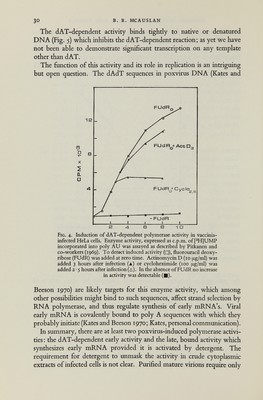
![ENZYMES SPECIFIED BY ANIMAL DNA VIRUSES 29 the polymerase must be incorporated into some minimal subviral struc¬ ture. Thus in the early stages of replication a polymerase is probably synthesized, combines with replicated DNA and transcribes 'late' mRNA (transcription of late mRNA in vitro has in fact been demonstrated with newly replicated viral DNA [Dahl and Kates 1970]). When viral DNA undergoes maturation, the rate of late mRNA synthesis drops (Fig. 2) and hours Fig. 3. Effect of rifampicin on the induction of polymerase activity in vaccinia-infected cells. Enzyme activity is expressed as c.p.m. of [®H]UMP incorporated into RNA. Assay conditions, as described by McAuslan (1969), utilize the detergent Nonidet P40. Superimposed on the curves representing activity in infected cells (•) or in cells infected in the presence of rifampicin (100 (xg/mJ) (o) is a curve representing the rate of viral mRNA synthesis in cells infected w^ith or w^ithout added rifampicin ( ). the packaged polymerase, perhaps now restricted by other structural proteins or the physical state of DNA, can potentially initiate only early mRNA sequences. In this way synthesis of late mRNA is prevented at early stages of the next rephcation cycle. A study of those proteins associated with subviral particles and their influence on the transition of late to early mRNA transcription is now required to test these ideas. During a search of a soluble form of the virion polymerase a dAT- primed poly AU-synthesizing activity was found to be induced (Pitkanen et al. 1969). This enzyme is an 'early' function dependent upon protein synthesis and, like virus-induced thymidine kinase (McAuslan 1963), has a very stable messenger (Fig. 4).](https://iiif.wellcomecollection.org/image/b18024956_0044.JP2/full/800%2C/0/default.jpg)