Copy 1, Volume 1
The gallery of nature and art; or, a tour through creation and science. Comprising new and entertaining descriptions of the most surprising volcanoes, caverns, cataracts, whirlpools, waterfalls, earthquakes, and other wonderful and stupendous phenomena of nature. Forming a rich and comprehensive view of all that is interesting and curious in every part of the habitable world. By the Rev. E. Polehampton, and John M. Good, F.R.S. Illustrated by one hundred engravings / [Edward Thomas William Polehampton].
- Polehampton, Edward (Edward Thomas William), 1777?-1830.
- Date:
- 1821
Licence: Public Domain Mark
Credit: The gallery of nature and art; or, a tour through creation and science. Comprising new and entertaining descriptions of the most surprising volcanoes, caverns, cataracts, whirlpools, waterfalls, earthquakes, and other wonderful and stupendous phenomena of nature. Forming a rich and comprehensive view of all that is interesting and curious in every part of the habitable world. By the Rev. E. Polehampton, and John M. Good, F.R.S. Illustrated by one hundred engravings / [Edward Thomas William Polehampton]. Source: Wellcome Collection.
64/570 page 42
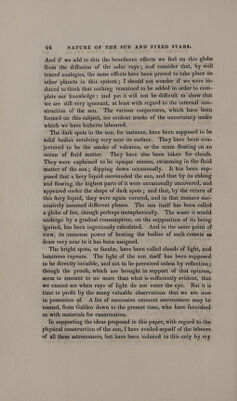
![livening of the parts of the other planets. And as for the fixed stars, he conceives them to be so many suns, and to be dispersed in the vast expansum of heaven, at various distances, and. each of them to have a proper system, and planets moved about them. And though it be impossible for us ever to see those planets, by reason of their vast distance, yet from the analogy that is between the sun and stars, we may judge of the planetary systems about them, and of the planets themselves too, which probably are like the planetary bodies about the sun, (that is) that they have plants and animals, nay, and rational ones too, as great admirers and observers of the heavens as any on the earth. This represents to us a wonderful scheme of the prodigious vastness of the heavens ; so that the distance between the earth and the sun, though of 17 millions of German miles, is almost nothing to the distance .of a fixed star. And because of the difficulty in making observations for this purpose, in the common ways, he therefore proposes a new method of his own for this purpose, which he also explains, and by that one may the better conceive the vastness of the distance of one of the nearest, as for instance, from the sun; which by. this way he proves to be 27,664 times the distance of the sun from the earth; and to make this distance yet more comprehensible, he makes use of the former explication, by the time that a cannon- bullet moved as swift as hath been just now explained. Where- fore multiplying 27,664 by 25, he finds that a cannon-bullet, mov- ing a hundred fathom in a second, would be 700,000 years in its journey betwixt us and the fixed stars; here by the way he makes some reflections on Des Cartesa’s Vortices, and explains his own sentiments concerning the present state of the universe, nor will he trouble his mind about their beginning, or how made, as knowing it to be out of the reach of human knowledge or conjecture, Upon the whole matter you will here find the ingenious author’s opinion concerning the universe, with all the arguments for it, drawn from the most accurate observations that have been hitherto made that are pertinent thereunto. The only failure seems to some to be in his opinion concerning the moon and secondary planets. Upon which subject there may perhaps be shortly pub- lished a brief discourse of one who is of a somewhat differing sentiment. ‘! [From the translation adopted by the Royal Society, 1699 ; and printed in the Phil. Trans. for the same year.]](https://iiif.wellcomecollection.org/image/b33091304_0001_0064.jp2/full/800%2C/0/default.jpg)