Licence: Public Domain Mark
Credit: Surgical appliances and minor operative surgery / by Thomas Annandale. Source: Wellcome Collection.
Provider: This material has been provided by the Royal College of Physicians of Edinburgh. The original may be consulted at the Royal College of Physicians of Edinburgh.
138/264 page 126
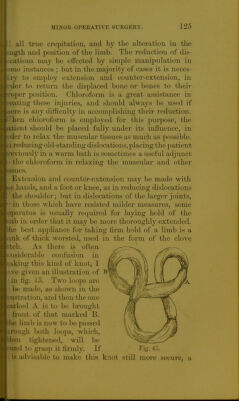
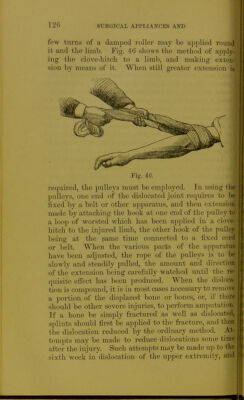
![few turns of a damped roller may be applied round it and the limb. Fig. 46 shows the method of apply- ing the clove-hitch to a limb, and making extenl sion by means of it. When still greater extension ■ Fig. 46. required, the pulleys must be employed. In using the pulleys, one end of the dislocated joint requires to be' fixed by a belt or other apparatus, and then extension] made by attaching the hook at one end of the pulley toj a loop of worsted which has been applied in a clove- hitch to the injured limb, the other hook of the pulley being at the same time connected to a fixed cord or belt. When the vai'ious parts of the apparatus have been adjusted, the rope of the pulleys is to be slowly and steadily pulled, the amount and direction of the extension being carefully watched until the re? quisite effect has been produced. When the disloca- tion is compound, it is in most cases necessary to remove a portion of the displaced bone or bones, or, if there should be other severe injuries, to perform amputation If a bone be simply fractured as well as dislocated, splints should first be applied to the fracture, and then the dislocation reduced by the ordinary method. At- tempts may be made to reduce dislocations some time after the injury. Such attempts may be made up to the sixth week in dislocation of the upper extremity, and](https://iiif.wellcomecollection.org/image/b21979352_0138.jp2/full/800%2C/0/default.jpg)
 No text description is available for this image
 No text description is available for this image
 No text description is available for this image