Licence: Public Domain Mark
Credit: Practical essays / by Sir Charles Bell. Source: Wellcome Collection.
Provider: This material has been provided by the Royal College of Physicians of Edinburgh. The original may be consulted at the Royal College of Physicians of Edinburgh.
248/308
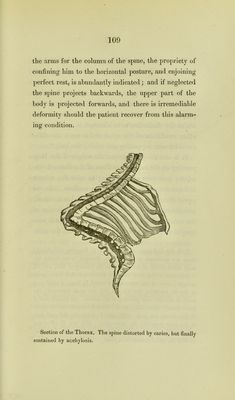
![The practice in such cases is accurately laid down in books ; in the attention to preserve the body at rest —to subdue the fever—to support the constitution— and when recovering, to sustain the spine both against incumbent pressure and lateral motion. It is not my purpose here to speak of this case any further than to notice the distinction to be observed in contrast with other conditions of the spine, and to mark the diffe- rence between supporting and raising the body.* It is one thing to prevent the weight of the body pressing on the inflamed surfaces of the diseased ver- tebrae ; it is quite another thing to raise the column and make a chasm between these surfaces. In one period of the disease the body may be raised or stretched, and the stature almost resumed, and the projection of the vertebrae diminished. But such a practice is con- trary to all principle, and highly dangerous; for when * In the Collection of the College of Surgeons [Edinburgh] there are specimens of this disease, dissected by me during the more active period of my life. See the Catalogue, 330, xxi. D, “ Vertebrae of the back carious ; the disease has made great ravages ; some of the vertebrae are united by bone; a small part of the 3d remains; the 6th and 7th are much destroyed; the heads of the ribs have partaken of the disease ; the patient died of hecticfever.” Ibid. 331, xix. F. Here the abscess and the walls of the abscess are seen. 328, xix. F. shews the inflamed state of the bone preceding the destruction. 332. xix. F. shews the transverse processes ancliylosed, whilst the bodies arc destroyed. In 333 tho spinal marrow is exposed.](https://iiif.wellcomecollection.org/image/b21962777_0248.jp2/full/800%2C/0/default.jpg)