Thomson's conspectus adapted to the British Pharmacopoeia of 1885 / edited by Nestor Tirard.
- Anthony Todd Thomson
- Date:
- 1887
Licence: Public Domain Mark
Credit: Thomson's conspectus adapted to the British Pharmacopoeia of 1885 / edited by Nestor Tirard. Source: Wellcome Collection.
Provider: This material has been provided by Royal College of Physicians, London. The original may be consulted at Royal College of Physicians, London.
58/284 page 30
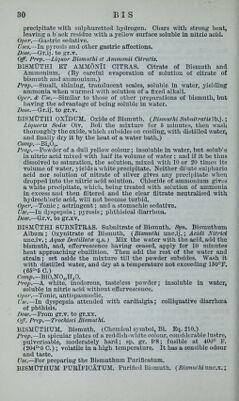
![precipitate with sulphuretted hydrogen. Chars with strong heat, leaving a b ack residue with a yellow surface soluble in nitric acid. Oper.—Gastric sedative. Uses.—In pyrosis and other gastric affections. Dose.—Gr.ij. to gr.v. Off. Prep.—Liquor Bismuthi et Ammonii Citraiis. BISMUTHI ET AMMONII CITRAS. Citrate of Bismuth and Ammonium. (By careful evaporation of solution of citrate of bismuth and ammonium.) Prop.—Small, shining, translucent scales, soluble in water, yielding ammonia when warmed with solution of a fixed alkali. Oper. & Use.—Similar to those of other preparations of bismuth, but having the advantage of being soluble in water. Dose.—Gr.ij. to gr.v. BISMUTHI OXIDUM. Oxide of Bismuth. {Bismuthi Subnit rat is ]b.j.; Liquoris Sodce Oiv. Boil the mixture for 5 minutes, then wash thoroughly the oxide, which subsides on cooling, with distilled water, and finally dry it by the heat of a water bath.) Comp.—Bi203. Prop.—Powder of a dull yellow colour; insoluble in water, but solub’e in nitric acid mixed with half its volume of water ; and if it be thus dissolved to saturation, the solution, mixed with 10 or 20 times its volume of water, yields a white precipitate. Neither dilute sulphuric acid nor solution of nitrate of silver gives any precipitate when dropped into the nitric acid solution. Chloride of ammonium gives a white precipitate, which, being treated with solution of ammonia in excess and then filtered and the clear filtrate neutralised with hydrochloric acid, will not become turbid. Oper.—Tonic ; astringent; and a stomachic sedative. Use.—In dyspepsia; pyrosis; phthisical diarrhoea. Dose.—Gr.v. to gr.xv, BISMUTHI SUBNITRAS. Subnitrate of Bismuth. Syn. Bismuthum Album; Oxynitrate of Bismuth. {Bismuthi unc.ij.; Acidi Kit net unc.iv.; Aquae Destillatce q.s.) Mix the water with the acid, add the bismuth, and, effervescence having oeased, apply for 10 minutes heat approaching ebullition. Then add the rest of the water and strain; set aside the mixture till the powder subsides. Wash it with distilled water, and dry at a temperature not exceeding 150°P. (65°*5 C.) Comp.—Bi0,N03,H20. Prop.—A white, inodorous, tasteless powder; insoluble in water, soluble in nitric acid without effervescence. Oper.—Tonic, antispasmodic. Use.—In dyspepsia attended with cardialgia; colliquative diarrhoea of phthisis. Dose.—Prom gr.v. to gr.xx. Off. Prep.—Trochisci Bismuthi. BISMUTHUM. Bismuth. (Chemical symbol, Bi. Eq. 210.) Prop.—In spicular plates of a reddish-white colour, considerable lustre, pulverisable, moderately hard; sp. gr. 9*8; fusible at 400° F. (204°’5 C.) ; volatile in a high temperature. It has a sensible odour and taste. Use.—For preparing the Bismuthum Purificatum. BISMUTHUM PURIFICATUM. Purified Bismuth. {Bismuthi unc.x.;](https://iiif.wellcomecollection.org/image/b24907819_0058.jp2/full/800%2C/0/default.jpg)