An Index of treatment / by various writers ; edited by Robert Hutchison and H. Stansfield Collier.
- Date:
- 1907
Licence: In copyright
Credit: An Index of treatment / by various writers ; edited by Robert Hutchison and H. Stansfield Collier. Source: Wellcome Collection.
Provider: This material has been provided by The University of Leeds Library. The original may be consulted at The University of Leeds Library.
870/904 page 850
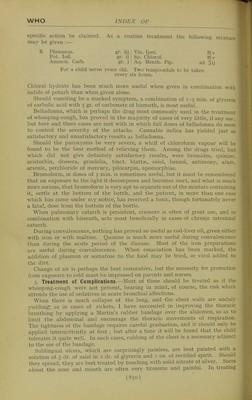
![specific action be claimed. As a routine treatment the following mixture may be given :— R Phenazon. Pot. lod. Ammon. Cturb. gr. iij gr- j For a child seven years old Vin. Ipec. Sp. Chlorof. Aq. Menth. Pip. Two teaspoonfuls to be taken n|v ni V ad 7) '\'] every six hours. Chloral hydrate has been much more useful when given in combination with iodide of potash than when given alone. Should vomiting be a marked symptom, a combination of 1-3 min. of glycerin of carbolic acid with 5 gr. of carbonate of bismuth, is most useful. Belladonna, which is perhaps the drug most commonly used in the treatment of whooping-cough, has proved in the majority of cases of very little, if any use; but here and there cases are met with in which full doses of belladonna do seem to control the severity of the attacks. Cannabis indica has yielded just as satisfactory and unsatisfactory results as belladonna. Should the paroxysms be very severe, a whiff of chloroform vapour will be found to be the best method of relieving them. Among the drugs tried, but which did not give definitely satisfactory results, were bromides, quinine, aristochin, drosera, grindelia, tinct. blattse, salol, benzol, antimony, alum, arsenic, perchloride of mercury, pilocarpin, apomorphiae. Bromoform, in doses of 5 min. is sometimes useful, but it must be remembered that on exposure to the light it decomposes and becomes inert, and what is much more serious, that bromoform is very apt to separate out of the mixture containing it, settle at the bottom of the bottle, and the patient, in more than one case which has come under my notice, has received a toxic, though fortunately never a fatal, dose from the bottom of the bottle. When pulmonary catarrh is persistent, creosote is often of great use, and in combination with bismuth, acts most beneficially in cases of chronic intestinal catarrh. During convalescence, nothing has proved so useful as cod-liver oil, given either with iron or with maltine. Quinine is much more useful during convalescence than during the acute period of the disease. Most of the iron preparations are useful during convalescence. When emaciation has been marked, the addition of plasmon or somatose to the food may be tried, or virol added to the diet. Change of air is perhaps the best restorative, but the necessity for protection from exposure to cold must be impressed on parents and nurses. 3. Treatment of Complications.—Most of these should be treated as if the whooping-cough were not present, bearing in mind, of course, the risk which attends the use of sedatives in acute bronchial affections. When there is much collapse of the lung, and the chest walls are unduly yielding, as in cases of rickets, I have succeeded in improving the thoracic breathing by applying a Martin's rubber bandage over the abdomen, so as to limit the abdominal and encourage the thoracic movements of respiration. The tightness of the bandage requires careful graduation, and it should only be applied intermittently at first ; but after a time it will be found that the child tolerates it quite well. In such cases, rubbing of the chest is a necessary adjunct to the use of the bandage. Sublingual ulcers, which are surprisingly painless, are best painted with a solution of i dr. of salol in 2 dr. of glycerin and i oz. of rectified spurit. Should they spread^ they are best treated by touching with solid nitrate of silver. Sores about the nose and mouth are often very tiresome and painful. In treatnig](https://iiif.wellcomecollection.org/image/b21509244_0870.jp2/full/800%2C/0/default.jpg)