Contributions to the military medical statistics of the Bombay Presidency / by John Kinnis.
- Kinnis, John.
- Date:
- 1851
Licence: Public Domain Mark
Credit: Contributions to the military medical statistics of the Bombay Presidency / by John Kinnis. Source: Wellcome Collection.
Provider: This material has been provided by The Royal College of Surgeons of England. The original may be consulted at The Royal College of Surgeons of England.
8/138 (page 4)
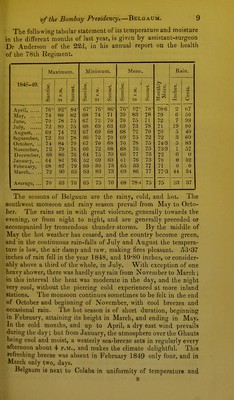
![Average. Max. Min. Hot season, March 1 to May 31, . 85^° ... 95° ... 79° Wet „ June 1 to Sept. 30, . 83^° ... 72° ... 50° Intermediate, Oct. 1 to Nov. 15, . 84° ... 95° ... 72° Cold season, Nov. 16 to Feb. 28, . 78° ... 85° .. 65° Betwixt the rainy and cold seasons the temperature is generally high, from the sun being still near, but without the clouds, which had intercepted his rays in the monsoon. The barometrical range is inconsiderable ; but the humidity of the atmosphere and of the soil, during the south-west monsoon, is very great. Fifty-three inches of rain have been known to fall in one montli, that of July, and the annual average of eleven years was 78*47. The soaking atmosphere of the monsoon, with the thermometer so high as 80°, imparts a sensation of cliilliness, every thing becomes damp and mouldy; a piece of polished iron will rust in a few hours, and ■woollen clotiiing is rendered indispensable. Thougli Colaba has been considered one of the healthiest spots in the Presidency, from November to May, the Queen's regiments do not always find it so. Fewer admissions may doubtless occur in December, January, and February, the coldest season, yet the casualties are more numerous in these than in any other months of the year, more especially from hepatic abscess and acute dysentery, separate or combined. The prevailing diseases are, remittent fever, dysentery, hepatitis, and not unfrequently cholera morbus, though, fortunately, there has been no very severe epide- mic visitation of that disease in any part of the command since 1846. b. Barracks.—Colaba Barracks are on the west side of the island, within from 50 to 100 yards of the sea-shore, and about twelve feet above high-water mark. They consist of six large buildings, here called pcndals, of burnt brick and mortar, with flag- stone floors, tiled roofs, and plastered walls, twenty inches thick, for single men ; and four, of a smaller size, of mud and bamboo, with clay floors, tiled roofs, and walls only four inches and a-half thick, for married men and their families. Large Pendals.—The large pendals are disposed in two pa- rallel lines, with a north-eastern aspect,—four in the first, two in the second,—at a distance of 140 feet betwixt the lines, and 100 feet betwixt every two of the same range. Every large pendal, with its verandah, ten feet wide, surrounding it, covers a surface of 230 by 43 feet, and is divided into one principal, and four small rooms for Serjeants at each end. The large room is 212 feet long, 23 wide, 13 high at the sides, 23 in the centre,-to the ridge pole. The floo:s of the front pendals are paved with a flagstone, so attractive of wiiter,][as to be never dry in damp or rainy weather.](https://iiif.wellcomecollection.org/image/b22270826_0008.jp2/full/800%2C/0/default.jpg)