Licence: Attribution-NonCommercial-NoDerivatives 4.0 International (CC BY-NC-ND 4.0)
Credit: Fungal genetics / J.R.S. Fincham and P.R. Day. Source: Wellcome Collection.
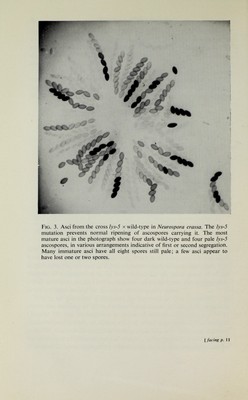
27/334 page 11
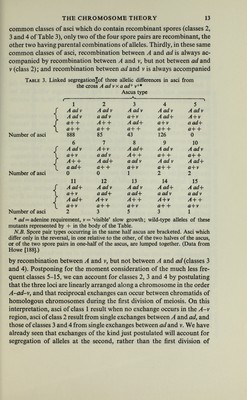
![THE CHROMOSOME THEORY 13 common classes of asci which do contain recombinant spores (classes 2, 3 and 4 of Table 3), only two of the four spore pairs are recombinant, the other two having parental combinations of alleles. Thirdly, in these same common classes of asci, recombination between A and ad is always ac¬ companied by recombination between A and v, but not between ad and V (class 2) ; and recombination between ad and v is always accompanied Table 3. Linked segregationjof three allelic differences in asci from the cross A ad VX a v+* Ascus type I 2 3 4 5 A ad V A ad V A ad v A ad v A ad v Aadv aadv a + v Aad+ A + v a++ A++ Aad+ a+v aad+ Ö++ + a++ Û+ + Number of asci 888 85 43 126 0 6 7 8 9 10 Aadv A-\-v Aad+ Aadv Aadv a+v aadv A++ a++ a+ + A++ A ad+ aadv Aadv A ad-\- a ad-\- a++ a+v ö++ a+v Number of asci 0 0 12 2 II 12 13 14 15 A ad+ Aadv Aadv A ad+ A ad+ a+v aad+ aad-\- aadv aadv Aad+ A + v A++ A + v A+ + a+v a++ a+v a++ a+v Number of asci 2 3 5 3 1 ♦ ai/= adenine requirement, V ='visible' slow growth; wild-type alleles of these mutants represented by + in the body of the Table. N.B. Spore pair types occurring in the same half ascus are bracketed. Asci which differ only in the reversal, in one relative to the other, of the two halves of the ascus, or of the two spore pairs in one-half of the ascus, are lumped together. (Data from Howe [188].) by recombination between A and v, but not between A and ad (classes 3 and 4). Postponing for the moment consideration of the much less fre¬ quent classes 5-15, we can account for classes 2, 3 and 4 by postulating that the three loci are linearly arranged along a chromosome in the order A-ad-v, and that reciprocal exchanges can occur between chromatids of homologous chromosomes during the first division of meiosis. On this interpretation, asci of class 1 result when no exchange occurs in the A~v region, asci of class 2 result from single exchanges between A and ad, and those of classes 3 and 4 from single exchanges between ad and v. We have already seen that exchanges of the kind just postulated will account for segregation of alleles at the second, rather than the first division of](https://iiif.wellcomecollection.org/image/B18023691_0028.JP2/full/800%2C/0/default.jpg)



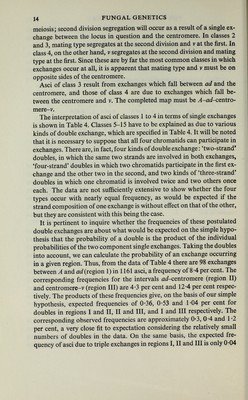
 No text description is available for this image
 No text description is available for this image
 No text description is available for this image