Content advisory
This digitised material is free to access, but contains information or visuals that may:
- include personal details of living individuals
- be upsetting or distressing
- be explicit or graphic
- include objects and images of objects decontextualised in a way that is offensive to the originating culture.
Licence: In copyright
Credit: DNA Sequencing. Source: Wellcome Collection.
5/132
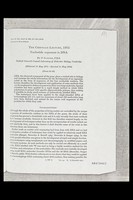
![DNA, the chemical component of the gene, plays a central role in biology and contains the whole information for the development of an organism, coded in the form of sequences of the four nucleotide residues. The lecture describes the development and application of some methods that can be employed to deduce sequences in these very large molecules. Special attention has been applied to a rapid simple method in which DNA polymerase is primed with specific oligonucleotide primers, thus making it possible to study small sections of radioactively labelled DNA. The techniques have been applied to the single-stranded DNA of bacteriophage <ßX 174, and two sequences of about 250 nucleotides long have been deduced and related to the amino acid sequences of the proteins for which they code. Introduction Although the whole of the properties of living matter are controlled by the unique sequences of nucleotide residues in the DNA of the genes, the study of these sequences has proved a formidable task and it is only recently that some methods have become available. Interest in this field has therefore centred largely on the development of techniques rather than on the interpretation of results (which are still relatively few), and in this lecture I shall describe some of the work in this direction from our laboratory. Earlier work on nucleic acid sequencing had been done with RNA and we had developed a number of techniques that could be applied to relatively small RNA molecules (Sanger, Brownlee & Barrell 1965; Brownlee & Sanger 1969). In this « ork special attention was given to the development of rapid and simple fraction ation techniques using ionophoresis and chromatography on modified papers and ''fun-layer systems. As such methods can only be carried out efficiently on a small RNA labelled with 32 P was used as being a highly sensitive method for the detection and estimation of the nucleotides. The methods were initially developed USin g small RNA molecules (transfer RNAs and the 5S RNA (Brownlee, Sanger ■ barrell 1968)). With further refinements it was shown that they could be applied t0 a bacteriophage RNA containing about 3000 residues, thus making possible the 20 [ 317 ] Vol. 191. b. (2 December 1975) abstract; Proc. if. Soc. Lond. B. 191, 317-333 (1975) printed in Great Britain The Croonian Lecture, 1975 Nucleotide sequences in DNA By F. Sanger, F.R.S. Medical Research Council Laboratory of Molecular Biology, Cambridge (.Delivered 15 May 1975 - Received 15 May 1975) [Plates 22-25]](https://iiif.wellcomecollection.org/image/b18189180_PP_CRI_H_5_21_0005.jp2/full/800%2C/0/default.jpg)