Mode of action of neuromuscular blocking agents / by W.D.M. Paton.
- William Paton
- Date:
- [1956?]
Licence: In copyright
Credit: Mode of action of neuromuscular blocking agents / by W.D.M. Paton. Source: Wellcome Collection.
11/12 page 479
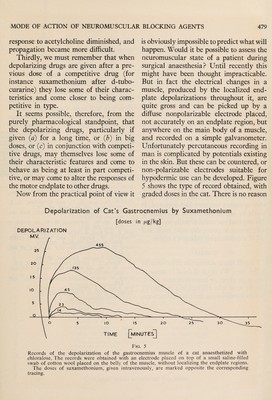
![response to acetylcholine diminished, and propagation became more difficult. Thirdly, we must remember that when depolarizing drugs are given after a pre¬ vious dose of a competitive drug (for instance suxamethonium after d-tubo- curarine) they lose some of their charac¬ teristics and come closer to being com¬ petitive in type. It seems possible, therefore, from the purely pharmacological standpoint, that the depolarizing drugs, particularly if given (a) for a long time, or (b) in big doses, or (c) in conjunction with competi¬ tive drugs, may themselves lose some of their characteristic features and come to behave as being at least in part competi¬ tive, or may come to alter the responses of the motor endplate to other drugs. Now from the practical point of view it is obviously impossible to predict what will happen. Would it be possible to assess the neuromuscular state of a patient during surgical anaesthesia? Until recently this might have been thought impracticable. But in fact the electrical changes in a muscle, produced by the localized end- plate depolarizations throughout it, are quite gross and can be picked up by a diffuse nonpolarizable electrode placed, not accurately on an endplate region, but anywhere on the main body of a muscle, and recorded on a simple galvanometer. Unfortunately percutaneous recording in man is complicated by potentials existing in the skin. But these can be countered, or non-polarizable electrodes suitable for hypodermic use can be developed. Figure 5 shows the type of record obtained, with graded doses in the cat. There is no reason Depolarization of Cat’s Gastrocnemius by Suxamethonium [doses in /ig/kg] DEPOLARIZATION Fig. 5 Records of the depolarization of the gastrocnemius muscle of a cat anaesthetized with chloralose. The records were obtained with an electrode placed on top of a small saline-filled swab of cotton wool placed on the belly of the muscle, without localizing the endplate regions. The doses of suxamethonium, given intravenously, are marked opposite the corresponding tracing.](https://iiif.wellcomecollection.org/image/b30634143_0011.jp2/full/800%2C/0/default.jpg)



 No text description is available for this image
 No text description is available for this image
 No text description is available for this image