Easy lessons in Egyptian hieroglyphics with sign list / by E.A. Wallis Budge.
- E. A. Wallis Budge
- Date:
- 1899
Licence: Public Domain Mark
Credit: Easy lessons in Egyptian hieroglyphics with sign list / by E.A. Wallis Budge. Source: Wellcome Collection.
46/266 page 30
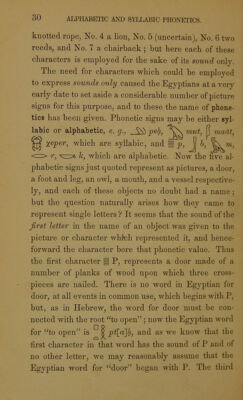
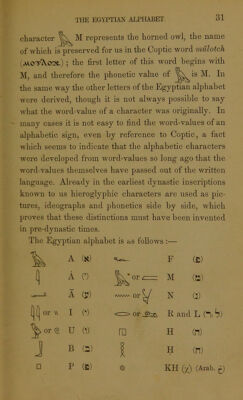
![ALPHABETIC AND SYLLABIC PHONETICS. knotted rope, No. 4 a lion, No. 5 (uncertain). No. 6 two reeds, and No. 7 a chairback ; but here each of these cbaracters is employed for tbe sake of its sound only. The need for characters which could be employed to express sounds only caused the Egyptians at a very early date to set aside a considerable number of picture signs for this purpose, and to these the name of phone- tics has been given. Phonetic signs may be either syl- labic or alphabetic, e. g., ^ peh, mut, maat, ^ Xeper, which are syllabic, and B p, J &, <=> r, k, which are alphabetic. Now the five al- phabetic signs just quoted represent as pictures, a door, a foot and leg, an owl, a mouth, and a vessel respective- ly, and each of these objects no doubt had a name ; but the question naturally arises how they came to represent single letters ? It seems that the sound of the Jirst letter in the name of an object was given to the picture or character which represented it, and hence- forward the character bore that phonetic value. Thus the first character B Pj represents a door made of a number of planks of wood upon which three cross- pieces are nailed. There is no word in Egyptian for door, at all events in common use, which begins with P, but, as in Hebrew, the word for door must be con- nected with the root “to open” ; now the Egyptian word for “to open” is ^ pt[a]h, and as we know that the first character in that word has the sound of P and of no other letter, we may reasonably assume that the Egyptian word for “door” began with P. The third](https://iiif.wellcomecollection.org/image/b24856897_0046.jp2/full/800%2C/0/default.jpg)