Content advisory
This digitised material is free to access, but contains information or visuals that may:
- include personal details of living individuals
- be upsetting or distressing
- be explicit or graphic
- include objects and images of objects decontextualised in a way that is offensive to the originating culture.
Licence: In copyright
Credit: [Notes on Curtis and "Collision Efficiency"]. Source: Wellcome Collection.
4/25
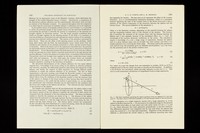
![those obtained by either of those groups. Ottewill and Shaw believed that there was a considerable discrepancy between most of their own experimental results and those theoretical results calculated from the optical constants of polystyrene and water using either the London, Slater-Kirkwood or Neugebauer values of A 22 for water. Watillon and Joseph-Petit pointed out that Ottewill and Shaw had used too high a value for the static polarizability of polystyrene, and suggested that recalculation of A 12 should give a value of 3.9 x 10 21 J. This value is close to the mean value obtained in our own measurements and similar to that calculated by Gregory 8 using the Lifshitz theory. Our measurements may indicate a better agreement between theory and experiment than has been obtained heretofore. This agreement and the relation ship between collision efficiency and shear rate provide considerable support for the theoretical treatment advanced in this paper. Table 1.—The observed collision efficiencies for different shear rates and the corresponding values of the london -H amaker constant, calculated from fio. 2. 0.63 55.2 1.3 1.79 45.0 6.1 8.18 41.5 1.4 30.17 37.5 2.3 77.2 34.0 2.6 92.3 32.1 1.9 112.0 31.8 2.1 The form of the plot of collision efficiency against shear rate (fig. 2) should ideally provide a means of identifying a value for the characteristic wavelength . Though it is doubtful that experimental results are sufficiently accurate to allow of a precise identification of the value of X it is of interest that the experimental results indicate a value close to that chosen on theoretical grounds. Although the measure ments were carried out under conditions in which adhesion should take place in the primary minimum the method is capable in theory of application to those situations in which adhesion takes place in the secondary minimum provided that (i) the distance of separation of the particles at equilibrium is known and (ii) computation problems are overcome. APPENDIX the hydrodynamic forces and the equations of motion The most convenient co-ordinate system is sketched in fig. 3. The spheres, of radius 1, have their centres at the points (0, 0, ±h). The direction of the x-axis is chosen so that the shear velocity lies in the plane y = 0 and makes an angle K—a with the z-axis. The magnitude of the shear velocity is W a +k l (x cos a+z sin a)+k 2 y, (Al) where W 0 is the velocity at the origin, and and k 2 are the shear rates in directions perpen dicular and parallel to the j-axis, respectively. The translational velocity of the spheres are (.U U U 2 ,U 3 )±(V U V 2 ,V 3 ) and the angular velocities (cOi,a) 2 ,co 3 )±(n l ,n 2 ,n 3 ), the upper and lower signs referring to the sphere with centre at z = ±A, respectively. The reason for writing the velocities in this way is that only the relative motion of the two spheres is required. To determine the fluid velocity at all points, and hence to determine the forces and couples on the spheres, it is necessary to solve the Stokes equations (since the Reynolds number is small), which, if u is the disturbance to the basic shear velocity caused by the presence and motion of the two spheres, are ij V 2 u = grad p, (A2) div u = 0 (A3) where p is the pressure, r¡ the viscosity of the fluid and V 2 is the Laplacian operator. The boundary conditions which u must satisfy are that u must tend to zero at large distances from the spheres and that the total fluid velocity must equal the velocity of the surface of the spheres at all points of contact. We now introduce polar coordinates in the x, y plane by writing x = r cos 0, y = r sin 0, and we ignore all parts of the solution which do not affect the relative motion of the spheres. The fluid velocity can be split into three parts, (A4) u] = 0, u\ = V 3 +k l sin a coso u 2 = {V 1 +m 2 (z-h)-k i sin 2 a z} cos 0, Uq = { — V t —a) 2 (z — h)+k¡ sin 2 a z} sin 0, (A6) u 2 = {-co 2 +k i cos 2 a}/' cos 0, r = {V 2 —cu 1 (z —ft)} sin 0, u¡ = {V 2 -<o l (z-h)}co$0, (A7) M z 3 = {(o t +k 2 cos a}r sin 0. The suffixes denote the three components of each part of the fluid velocity. Similar boundary conditions can be written down for the other sphere, but it is sufficient to require that ul be an odd function of z, and ui and «I even functions of z. The first part of u contributes to the force in the z-direction, the second part to the force in the ^-direction and the couple about the _y-axis and the third to the force in the ^-direction and the couple about the x-axis. The couple about the z-axis need not be determined as its only function is to fix the angular velocity about this axis, which does not affect the relative motion of the spheres.](https://iiif.wellcomecollection.org/image/b18182458_PP_CRI_H_4_21_0004.jp2/full/800%2C/0/default.jpg)