Content advisory
This digitised material is free to access, but contains information or visuals that may:
- include personal details of living individuals
- be upsetting or distressing
- be explicit or graphic
- include objects and images of objects decontextualised in a way that is offensive to the originating culture.
Licence: In copyright
Credit: [Correspondence]. Source: Wellcome Collection.
4/31
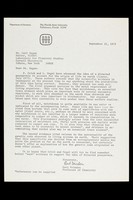
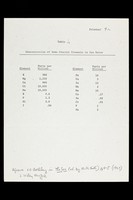
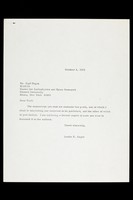
![Department of Chemistry The Florida State University Tallahassee, Florida 32306 r ±±£] lïïïïïïj September 21, 1973 Dr. Carl Sagan Editor, ICARUS Laboratory for Planetary Studies Cornell University Ithaca,. New York 14850 Dear Dr. Sagan: F. Crick and L. Orgel have advanced the idea of a directed panspermia to account for the origin of life on earth (Icarus, July 1973). These authors concede that the scientific evidence is inadequate at the present time to say anything about the probability of this idea being correct. However, they present two weak evi dences. The first argument pertains to the metal requirement of living organisms. They cite the fact that molybdenum, an essential trace element which plays an important role in several enzymatic reactions, is much less abundant on the earth than chromium and nickel which are less important in biochemistry. Any argument based upon this contention is even weaker than these authors realize. First of all, molybdenum is quite available in sea water as indicated by the accompanying_table. Since life may have been de rived from systems that were in some sort of equilibrium with sea water (tidal pools, etc.), perhaps we should be more concerned with why molybdenum is not involved in a larger number of reactions more comparable to copper or zinc, which it exceeds in concentration in sea water. This discrepancy probably arises from the less successful interaction of molybdate ion, (M0O4) with proteins and nucleic acids compared to copper and zinc. It is also true that chromium has been shown to be essential to animal systems*, and evidence is ac cumulating that nickel also may be an essential trace element*. The second evidence cited relates to the universality of the genetic code observed in living systems on earth. Their suggestion that this specificity was derived from an extraplanetary source may solve the problem as far as the earth is concerned, but certainly doesn't offer an explanation of how the genetic code originated on some other planet. It is hoped that Crick and Orgel will try to find somewhat better weak evidence to support the idea of directed panspermia. Sincerely, Qfrdi Òcùjidles K Earl Frieden Professor of Chemistry References can be supplied](https://iiif.wellcomecollection.org/image/b18169302_PP_CRI_H_5_7_2_0004.jp2/full/800%2C/0/default.jpg)