An introduction to natural philosophy. Or, Philosophical lectures read in the University of Oxford anno Dom. 1700. To which are added the demonstrations of Monsieur Huygens's Theorems, concerning the centrifugal force and circular motion / By John Keill ... Translated from the last edition of the Latin.
- John Keill
- Date:
- 1720
Licence: Public Domain Mark
Credit: An introduction to natural philosophy. Or, Philosophical lectures read in the University of Oxford anno Dom. 1700. To which are added the demonstrations of Monsieur Huygens's Theorems, concerning the centrifugal force and circular motion / By John Keill ... Translated from the last edition of the Latin. Source: Wellcome Collection.
320/328 (page 304)
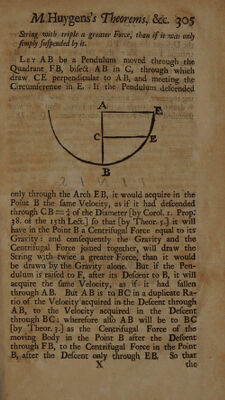
![confequently [by 9 EJ. 4.] the 'Time of the Revolu: tion of the moving Body C, will be equal to the I ime of the perpendicular Fall from a Height equal tothe Length of the Pendulum. .Q. E. D. Bur fince P isto D nearly as 314 to 100, p will be to 2 D^-as.98596 to 5000. - But ACis to AE, from the foregoing. Demonftration, as P* tó 1D*; wherefore 98596 is to 5000 as AC to AE, and as AC to AE, fo is [by Trigonometry | the Sine of the Angle AEG, or Radius rooooo to the Sine of the Ansle ACE: but 98596 is to 5000 as 100000 to 5070, which therefore is the Sine of the Angle ACE, to which nearly aníwer 2 Degrees ; 34 Minutes | B rd 1 x Tr two Páililiy vai in T- re having hh Strings unequal, do vévokue iu a Conical Motion, ' and ^ ‘the Heights of the Cones*are equal, she Forces where- . with they firetcb their Strings, will be in the Jame Ratio, | as is that y the Length VR tbe Sicut : 4. Ux bu. m Tuis is ! addat &óm Tid 2 Tp the Forte | of Gravity in both the itu 48 to the 'l'enfion of the. is. as the Hei t of the Cone to the - ‘Length of the String ; 3 as. fince the Height of the - “Cones is the fame, it is evident that. fhe 'lenfions | ‘of the gd are ERROR UMS, S to their Lengths. © | : ANE OR, Wm fest ds a uff mple Pexdulinéts kdved wisbthe- iud Jateral — > Ofcillation, that is, if it: defends through the whole i ‘Quadrant of a Circle, when it fball: arrive at the / NÉ Point of the Gir curhference; at will deat its ner CS # un ae ca coe aie](https://iiif.wellcomecollection.org/image/b30500552_0320.jp2/full/800%2C/0/default.jpg)