Insanity tested by science, and shown to be a disease rarely connected with permanent organic lesion of the brain : and on that account far more susceptible of cure than has hitherto been supposed / by C.M. Burnett, M.D.
- Burnett, C. M. (Charles Mountford), 1807-1866
- Date:
- 1848
Licence: Public Domain Mark
Credit: Insanity tested by science, and shown to be a disease rarely connected with permanent organic lesion of the brain : and on that account far more susceptible of cure than has hitherto been supposed / by C.M. Burnett, M.D. Source: Wellcome Collection.
Provider: This material has been provided by University of Bristol Library. The original may be consulted at University of Bristol Library.
117/128 page 105
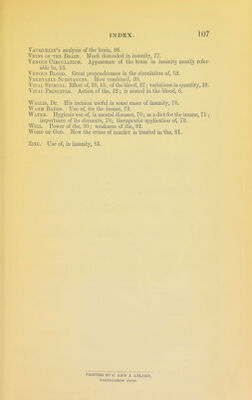
![Neguo. Why he is not subject to insanity, 52. Nerves. How engaged in the process of assimilation, 23 ; materials com- posing the, 26. Nebvous Diseases. What constitutes, IG. Nitrate of Silver. See Silver. Non-residence of able physicians in lunatic asylums, evils of, 98. Ointment of Tartar Emetic. Sometimes very useful in insanity, a])plicd to the head, 80. Office of the liver, lungs, skin, and kidneys, 38. Ogston, Dr. On the presence of cilcohol in the vital organs, 47. Opium. Its use in puerpertd mania, 81; in melancholia and hypochon- driasis, 74 ; Dr. Seymour's mode of administering, 82. Organs op the Body. Why several become affected in insanity, 48. Organic Tissues. Variable power of the, 39. Organic Diseases. Probable cause of, 53 ; of one organ depends on another, 56. Organic and Inorganic Bodies. Difference in the union of, 19; Fletcher's distinction between, 23. Organized Bodies. Cause of the complexit;^ in, 21. Orrery, Lord. On the causes of insanity in Great Britain, 67; on the consequences of the freedom of our laws, 92. Oxygen. Power of, to break up the tissues, 26. Paralysis. The cause or consequence of a particular condition of the muscles, 49. Pathology. Conflicting statements of, in mental diseases, 12; of the blood in insanity, 44, 48 ; Immoral, applied to insanity, 4. Passions. Were thought to reside in the viscera of the chest and abdo- men, 10; opinions of philosophers and physiologists on their seat, 10. Percival, Dr. Treatment of epilepsy, 84; on the use of turpentine, 84. Percy, Dr. On the effects of alcohol upon the brain, 46. Persevering conduct of the insane over their food, 74. Potash. Predominates in the muscular tissues, 37. Predisposing Causes. Effect of, upon the blood, 40. Protean Theory. Does nothing for ultimate analysis, 24. Process of Thought. On what does it depend, 45. Prout, Dr. Deiinition of tlie power of the vital principle, 21; on carbonic acid in the blood, 39 ; on diet, 86. Proximate Principles of organized bodies, engaged by the vital prin- ciple, 22. Phosphorus. Its existence in the blood, 24 ; an element of cerebral and nervous tissue, 26; its peculiar properties, 27; how united in the blood, 27; how united in the brain, 26; deficient in the brains of Cretins, 17; its use in forming the tissues, 36; its use as a remedy for the insane, 86 ; probable mode of action, 87; is contained in the alvine secretions, 80. Phosphate op Soda. Necessary to the blood, 37; its power to absorb carbonic acid in the blood, 37. Psychological views of insanity, 90. Physical treatment of the insane, 95 ; mistake in the meaninG- of the word, 95,96. ^ Prussic Acid. Use of, in melancholia and hypochondriasis, 82. Purgatives. Use of, in insanity, 80; effects of, 80. Quinary compounds in the blood, 20.](https://iiif.wellcomecollection.org/image/b21445035_0117.jp2/full/800%2C/0/default.jpg)