The preparation and properties of thrombin, together with observations on antithrombin and prothrombin / by W.H. Howell.
- William Henry Howell
- Date:
- [1910?]
Licence: Public Domain Mark
Credit: The preparation and properties of thrombin, together with observations on antithrombin and prothrombin / by W.H. Howell. Source: Wellcome Collection.
3/28 page 453
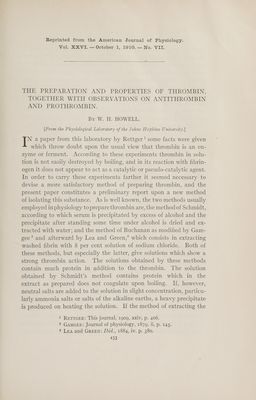
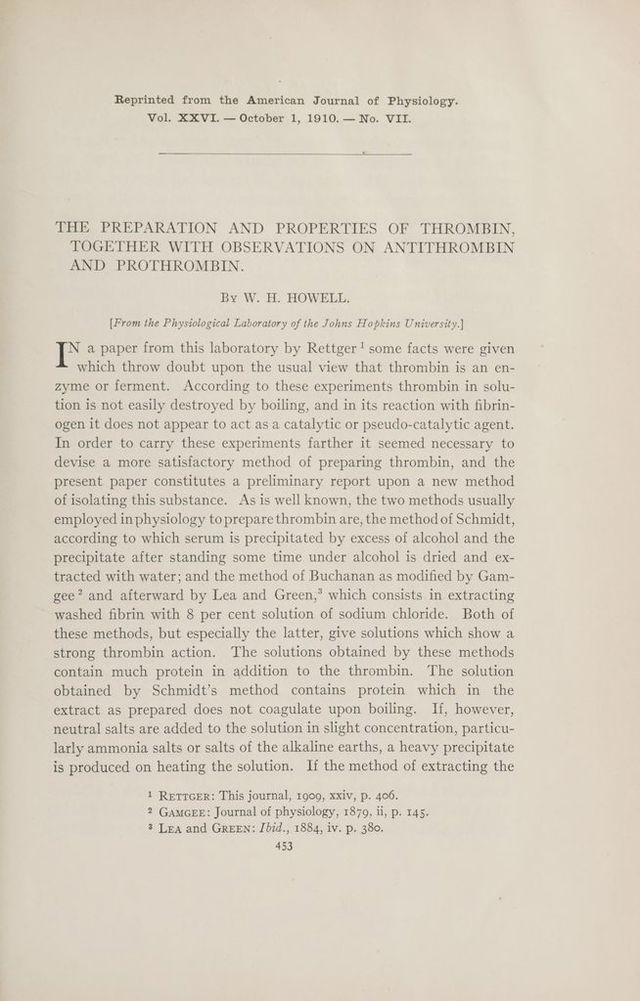
![Reprinted from the American Journal of Physiology. Vol. XXVI. — October 1, 1910. — No. VII. THE PREPARATION AND PROPERTIES OF THROMBIN, TOGETHER WITH OBSERVATIONS ON ANTITHROMBIN AND PROTHROMBIN. By W. H. HOWELL. [From the Physiological Laboratory of the Johns Hopkins University.] N a paper from this laboratory by Rettger! some facts were given which throw doubt upon the usual view that thrombin is an en- zyme or ferment. According to these experiments thrombin in solu- tion is not easily destroyed by boiling, and in its reaction with fibrin- ogen it does not appear to act as a catalytic or pseudo-catalytic agent. In order to carry these experiments farther it seemed necessary to devise a more satisfactory method of preparing thrombin, and the present paper constitutes a preliminary report upon a new method of isolating this substance. As is well known, the two methods usually employed in physiology to prepare thrombin are, the method of Schmidt, according to which serum is precipitated by excess of alcohol and the precipitate after standing some time under alcohol is dried and ex- tracted with water; and the method of Buchanan as modified by Gam- gee” and afterward by Lea and Green,’ which consists in extracting washed fibrin with 8 per cent solution of sodium chloride. Both of these methods, but especially the latter, give solutions which show a strong thrombin action. The solutions obtained by these methods contain much protein in addition to the thrombin. The solution obtained by Schmidt’s method contains protein which in the extract as prepared does not coagulate upon boiling. If, however, neutral salts are added to the solution in slight concentration, particu- larly ammonia salts or salts of the alkaline earths, a heavy precipitate is produced on heating the solution. If the method of extracting the 1 RETTGER: This journal, 1909, xxiv, p. 406. 2 GAMGEE: Journal of physiology, 1879, li, p. 145. 3 Lea and GREEN: Jbid., 1884, iv. p. 380.](https://iiif.wellcomecollection.org/image/b33441182_0003.jp2/full/800%2C/0/default.jpg)