Licence: Public Domain Mark
Credit: On banded and brecciated concretions / by John Ruskin. Source: Wellcome Collection.
Provider: This material has been provided by The Royal College of Surgeons of England. The original may be consulted at The Royal College of Surgeons of England.
3/6
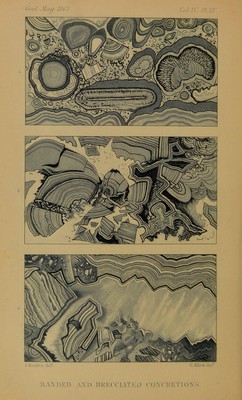
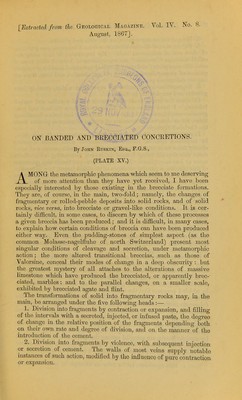
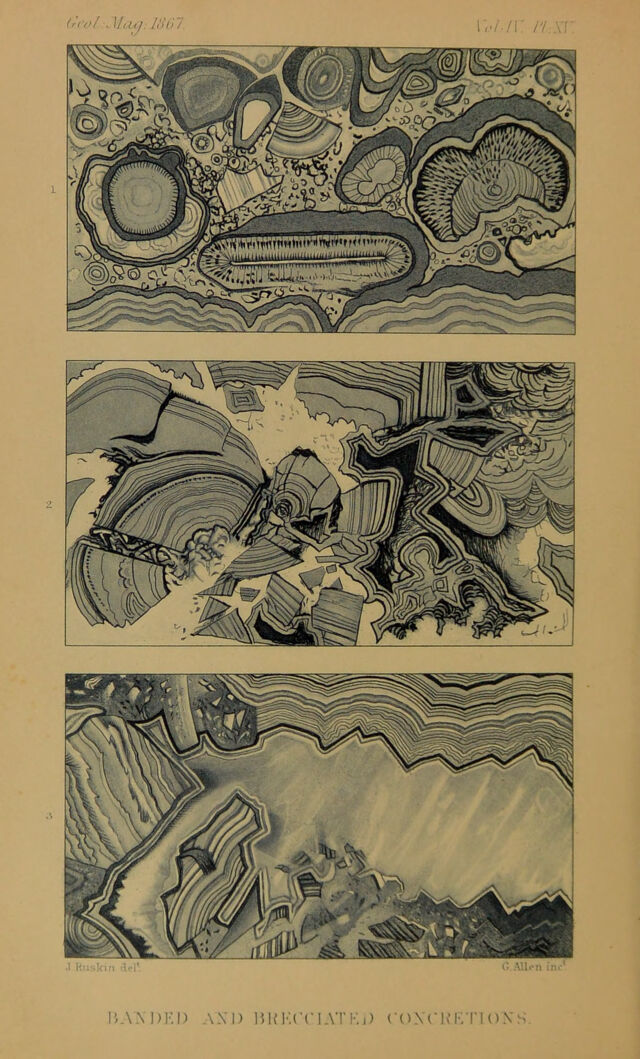
![[Extracted from the Geological Magazine. Yol. IT. No. 8 August, 1867]. V -*■' / fc *V-' ON BANDED AND BRECCIATED CONCRETIONS. By John Rusiun, Esq,, F.G.S., (PLATE XV.) MONG the metamorphic phenomena which seem to me deserving of more attention than they have yet received, I have been especially interested by those existing in the brecciate formations. They are, of course, in the main, two-fold; namely, the changes of fragmentary or rolled-pebble deposits into solid rocks, and of solid rocks, vice versa, into brecciate or gravel-like conditions. It is cer- tainly difficult, in some cases, to discern by which of these processes a given breccia has been produced; and it is difficult, in many cases, to explain how certain conditions of breccia can have been produced either way. Even the pudding-stones of simplest aspect (as the common Molasse-nagelfluhe of north Switzerland) present most singular conditions of cleavage and secretion, under metamorphic action; the more altered transitional breccias, such as those of Valorsine, conceal their modes of change in a deep obscurity : but the greatest mystery of all attaches to the alterations of massive limestone which have produced the brecciated, or apparently brec- ciated, marbles: and to the parallel changes, on a smaller scale, exhibited by brecciated agate and flint. Tho transformations of solid into fragmentary rocks may, in the main, bo arranged under the five following heads:— 1. Division into fragments by contraction or expansion, and filling of tho intervals with a secreted, injected, or infused pasto, the degreo of change in tho relative position of tho fragments depending both on their own rate and degree of division, and on the manner of tho introduction of the cement. 2. Division into fragments by violence, with subsequent injection or secretion of cement. Tho walls of most veins supply notable instances of such action, modified by tho influence of pure contraction or expansion.](https://iiif.wellcomecollection.org/image/b22395519_0005.jp2/full/800%2C/0/default.jpg)