Licence: Public Domain Mark
Credit: The anatomy of the human body / By J. Cruveilhier. Source: Wellcome Collection.
Provider: This material has been provided by the University of Massachusetts Medical School, Lamar Soutter Library, through the Medical Heritage Library. The original may be consulted at the Lamar Soutter Library at the University of Massachusetts Medical School.
136/944 (page 112)
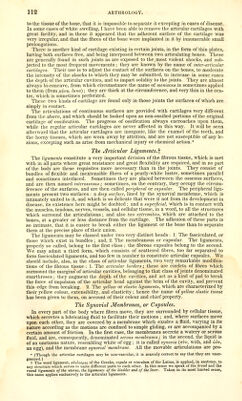
![to the tissue of the bone, that it is impossible to separate it excepting in cases of disease. In some cases of white sweUing, I have been able to remove the articular cartilages with great facihty, and in these it appeared that the adherent surface of the cartilage was very irregular, and that the fibres of the bone were implanted in it by innumerable small prolongations. There is another kind of cartilage existing in certain joints, in the form of thin plates, having both surfaces free, and being interposed between two articulating bones. These are generally found in such joints as are exposed to the.most violent shocks, and sub- jected to the most frequent movements ; they are known by the name of inter-articular cartilages. Their use is to adjust the contact of the surfaces on the bones, to moderate the intensity of the shocks to which they may be submitted, to increase in some cases the depth of the articular cavities, and to impart solidity to the joints. They are almost always bi-concave, from which circumstance the name of meniscus is sometimes apphed to them (from iirivrj, luna) ; they are thick at the circumference, and very thin in the cen- tre, which is sometimes perforated. These two kinds of cartilage are found only in those joints the surfaces of which are simply in contact. The articulations of continuous surfaces are provided with cartilages very different from the above, and which should be looked upon as non-ossified portions of the original cartilage of ossification. The progress of ossification always encroaches upon them, while the regular articular cartilages are never affected in this way. It will be seen afterward that the articular cartilages are inorganic, like the enamel of the teeth, and the horny tissues, which are worn away by attrition, and are not susceptible of any le- sions, excepting such as arise from mechanical injury or chemical action.* The Articular Ligaments.\ The ligaments constitute a very important division of the fibrous tissue, vrhich is met with in all parts where great resistance and great flexibility are required, and in no part of the body are these requisites more necessary than in the joints. They consist of bundles of flexible and inextensible fibres of a pearly-white lustre, sometimes parallel and sometimes interlaced. Sometimes they are placed between the osseous surfaces, and are then named interosseous; sometimes, on the contrary, they occupy the circum- ference of the surfaces, and are then cdlleA peri-pheral or capsular. The peripheral liga- ments present two surfaces : a deep surface, lined by the synovial membrane, which is intimately united to it, and which is so delicate that were it not from its development in disease, its existence here might be doubted ; and a superjicial, which is in contact with the muscles, tendons, nerves, vessels, and cellular tissue, in a word, to all the structures which surround the articulations; and also tico extremities, which are attached to the bones, at a greater or less distance from the cartilage. The adhesion of these parts is so intimate, that it is easier to break either the hgament or the bone than to separate them at the precise place of their union. The ligaments may be classed under two very distinct heads : 1. The fasciculated, or those which exist in bundles; and, 2. The membranous or capsular. The ligaments, properly so called, belong to the first class ; the fibrous capsules belong to the second. We may admit a third form, which consists of scattered fibres, too far separated to form fasciculated ligaments, and too few in number to constitute articular capsules. We should include, also, in the class of articular ligaments, two very remarkable modifica- tions of the fibrous tissue: 1. The articular borders; these are circlets of fibres which surmount the margins'of articular cavities, belonging to that class of joints denominated enarthroses ; they augment the depth of the cavities, and act as a kind of pad to break the force of impulsion of the articular head against the brim of the cavity, and prevent this edge from breaking. 2. The yelloiv or elastic ligaments, which are characterized by their yellow colour, extensibility, and elasticity ; hence the name of yellow elastic tissue has been given to them, on account of their colour and chief property. The Synovial Membranes, or Capsules. In every part of the body where fibres move, they are surrounded by cellular tissue, which secretes a lubricating fluid to facilitate their motions ; and, where surfaces move upon each other, they are covered by a membrane which exudes a fluid, varying in its nature according as the motions are confined to simple gliding, or are accompanied by a certain amount of friction. In the first case, the membranes secrete a watery or serous fluid, and are, consequently, denominated serous membranes; in the second, the hquid is of an unctuous nature, resembling white of egg ; it is called synovia {avv, with, and udv, an egg), and the membrane synovial membrane. All the movable articulations are pro- * [Though the articular cartilages may be non-vascular, it is scarcely correct to say that they are unor- ganized.] 1 J • t The word ligament, avvSeafio; of the Greeks, copula or vinculum of the Latins, is applied, in anatomy, to any structure which serves to unite different parts to each other. In this sense we speak of the broad and the round ligaments of the uterus, the ligaments of the bladder and of the liver. Taken in its most limited sense, this name aoplies exclusively to the articular ligaments.](https://iiif.wellcomecollection.org/image/b21196801_0136.jp2/full/800%2C/0/default.jpg)