Licence: Public Domain Mark
Credit: The anatomy of the human body / By J. Cruveilhier. Source: Wellcome Collection.
Provider: This material has been provided by the University of Massachusetts Medical School, Lamar Soutter Library, through the Medical Heritage Library. The original may be consulted at the Lamar Soutter Library at the University of Massachusetts Medical School.
163/944 (page 139)
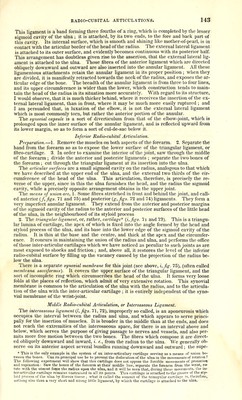
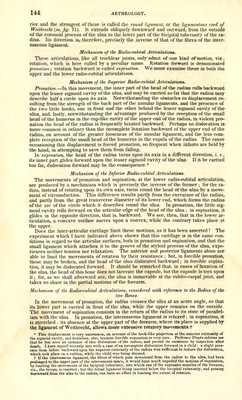
![surrounding tendons. The following are the relations of the capsule : 1. Below, in the variable space between the subscapularis and teres minor, it corresponds to the cellular tissue of the axilla, or, rather, to the thin edges of the muscles just mentioned : the head of the humerus may, therefore, be easily felt by the fingers introduced deeply into the axilla. 2. Above and on the outside, it is in contact with the tendon of the supra-spi- natus, from which it is difficult to separate it, and is also in relation, though not immedi- ately, with the arch formed by the acromion and clavicle with the deltoid muscle. 3. In front, it corresponds to the subscapular muscle, from which it may be easily separated. 4. Behind, it corresponds to the tendons of the supra and infra spinatus, which are more or less adherent to it, and the teres minor, which does not adhere to it. As to its struc- ture, it is composed of fibres stretched irregularly from the neck of the humerus to the circumference of the glenoid cavity. Its thickness is not great, nor is it equal through- out, being most considerable below and in front; but the capsule is strengthened above by a considerable bundle of fibres {s,fig. 69), called the coracoid ligament, coracn-humeral ligament, or accessory ligament of the fibrous capsule, which arises from the anterior edge of the coracoid process, and spreads out on the capsule. This capsule always presents an opening or an interruption above and before,* on a level with the superior border of the subscapularis, which covers the opening in part; or, rather, between this border and the coracoid process. This opening is of an oval form; its greatest diameter is horizontal; its large extremity is turned outward, and its small extremity inward. The circumference of this opening, which is large enough to admit the point of the index fin- ger, is perfectly smooth, thick, and looks like mother-of-pearl, especially in its inferior half This opening is traversed by a considerable prolongation of the synovial mem- brane, which reaches the basis of the coracoid process, and then extends between the tendon of the subscapularis and the cavity which bears the same name. This cone- shaped prolongation is variable with respect to its extent, and appears to have no other object except to facilitate the gliding of the tendon of the subscapularis under the cora- coid arch and against the border of the glenoid cavity. By distending the articular cap- sule in several subjects, Mr. Bonamy has demonstrated this disposition to my perfect satisfaction. I have been able to see that the synovial prolongation is sometimes divi- ded into several cells by incomplete walls, by which this distended prolongation acquires a crimpled aspect. Sometimes several of these cells are totally distinct from the syno- vial membrane. Inter-articular Ligament.—This name may, with propriety, he applied to the tendon {t, fig. 70) of the long head of the biceps, which, arising from the upper part of the glenoid cavity, turns hke a cord over the head of the humerus, and passes along the bicipital groove. It acts by keeping the head of the humerus applied to the glenoid cavity, and forms a sort of arch that supports the bone when it is forced upward. In two subjects, I found this tendon terminating by a strong adhesion in the bicipital groove, and thus justifying the name of inter-articular ligament, which I have applied to it: the tendon for the long head of the biceps took its origin from the same groove. I consider this division of the tendon to have been accidental, for the bicipital groove was depressed, and the inter-articular ligament flattened, and, as it were, lacerated. The synovial capsule is the simplest of all in regard to its disposition. It lines the fibrous capsule and the tendons which replace it, and is reflected, on one side, on the neck of the humerus, and, on the other, upon the border of the glenoid cavity, to be lost upon the circumference of the articular cartilages. It is remarkable, inasmuch as, 1. It forms a fold round the tendon of the biceps, which is prolonged into the bicipital groove, and terminates below by a cul-de-sac or circular fold, which prevents the effusion of the synovia; 2. It is open in one or two points,! and presents two prolongations communi- cating with the synovial bursae of the subscapularis and infra-spinatus. Supplementary Cavity.—We may regard as a dependance of the scapulo-humeral artic- ulation the vaulted arch formed by the coracoid and acromion processes, and the liga- ment which unites them. In shape it corresponds to the head of the humerus, and is so constructed that the coracoid process prevents displacement inward ; the acromion pre- vents it upward and outward ; and the ligament between them opposes dislocation di- rectly upward. This provision evidently compensates for the incomplete reception of the head of the humerus in the glenoid cavity. A circumstance which proves the use- fulness of this vault, and the frequent contacts which it must have with the humerus, is the presence of a synovial capsule, situated between the coraco-acromion vault on one * I have seen this opening- divided into two unequal portions by a fibrous bundle, strong, looking- like mother- of-pearl, and resemliling a little tendon. Often 1 have met a second interruption of the fibrous ca))sule on a level -with the concave border of the acromion process, which concave border acts as a real returu-puUey for the infra-spinatus muscle, and is analogous to the return-pulley presented l)y the basis of the coracoid process to the subscapularis muscle. When the capsule is perforated at this point, the synovial membrane gives off a prolongation, which serves as a gliding capsule for the tendon of the infra-spinatus. t [Although the synovial capsule of the shoulder-joint is thus occasionally prolonged into the bursa; mucosa connected with the tendons of these muscles, it must not, therefore, be supposed that it is an exception to tha general rule that membranes of this nature always form shut sacs ; in stich cases, the three structures consti- tute one continuous cavity.]](https://iiif.wellcomecollection.org/image/b21196801_0163.jp2/full/800%2C/0/default.jpg)