Licence: Public Domain Mark
Credit: The anatomy of the human body / By J. Cruveilhier. Source: Wellcome Collection.
Provider: This material has been provided by the University of Massachusetts Medical School, Lamar Soutter Library, through the Medical Heritage Library. The original may be consulted at the Lamar Soutter Library at the University of Massachusetts Medical School.
35/944 (page 11)
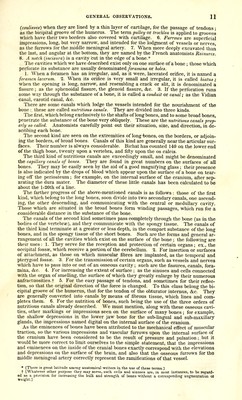
![(coulisses) when they are lined by a thin layer of cartilage, for the passage of tendons ; as the bicipital groove of the humerus. The term pulley or trochlea is applied to grooves which have their two borders also covered with cartilage. 6. Furrows are superficial impressions, long, but very narrow, and intended for the lodgment of vessels or nerves, as the furrows for the middle meningeal artery. 7. When more deeply excavated than the last, and angular at the bottom, they are named by the French anatomists Rainures. 8. A notch {incisura) is a cavity cut in the edge of a bone.* The cavities which we have described exist only on one surface of a bone ; those which perforate its substance are usually denominated foramina or holes. 1. When a foramen has an irregular, and, as it were, lacerated orifice, it is named a foramen lacerum. 2. When its orifice is very small and irregular, it is called hiatits; when the opening is long, narrow, and resembling a crack or slit, it is denominated a fissure ; as the sphenoidal fissure, the glenoid fissure, &.c. 3. If the perforation runs some way through the substance of a bone, it is called a conduit or canal; as the Vidian canal, carotid canal, &c. There are some canals which lodge the vessels intended for the nourishment of the bone : these are called nutritious canals. They are divided into three kinds. The first, which belong exclusively to the shafts of long bones, and to some broad bones, penetrate the substance of the bone very obliquely. These are the nutritious canals prop- erly so called. Anatomists carefully point out their situation, size, and direction, in de- scribing each bone. The second kind are seen on the extremities of long bones, on the borders, or adjoin- ing the borders, of broad bones. Canals of this kind are generally near the articular sur- faces. Their number is always considerable. Bichat has counted 140 on the lower end of the thigh bone, twenty upon a vertebra, and fifty upon the os calcis. The third kind of nutritious canals are exceedingly small, and might be denominated the capillary canals of bones. They are found in great numbers on the surfaces of all bones. They may be easily seen by the aid of a good magnifying glass ; their presence is also indicated by the drops of blood which appear upon the surface of a bone on tear- ing off the periosteum ; for example, on the internal surface of the cranium, after sep- arating the dura mater. The diameter of these little canals has been calculated to be about the I-20th of a line. The farther progress of the above-mentioned canals is as follows : those of the first kind, which belong to the long bones, soon divide into two secondary canals, one ascend- ing, the other descending, and communicating with the central or medullary cavity. Those which are situated in the broad bones form winding passages, which run for a considerable distance in the substance of the bone. The canals of the second kind sometimes pass completely through the bone (as in the bodies of the vertebrae), and they communicate with the spongy tissue. The canals of the third kind terminate at a greater or less depth, in the compact substance of the long bones, and in the spongy tissue of the short bones. Such are the forms and general ar- rangement of all the cavities which exist on the surface of the bone; the following are their uses : 1. They serve for the reception and protection of certain organs ; ex., the occipital fossae, which receive a portion of the cerebellum. 2. For insertion or surfaces of attachment, as those on which muscular fibres are implanted, as the temporal and pterygoid fossae. 3. For the transmission of certain organs, such as vessels and nerves which have to pass into or out of an osseous cavity ; such are the fissures, canals, fora- mina, &.C. 4. For increasing the extent of surface ; as the sinuses and cells connected with the organ of smelling, the surface of which they greatly enlarge by their numerous anfractuosities.t 5. For the easy passage of tendons, and sometimes for their reflec- tion, so that the original direction of the force is changed. To this class belong the bi- cipital groove of the humerus, that for the tendon of the obturator internus, &c. They are generally converted into canals by means of fibrous tissue, which lines and com- pletes them. 6. For the nutrition of bones, such being the use of the three orders of nutritious canals already described. We must mention, along with these osseous cavi- ties, other markings or impressions seen on the surface of many bones; for example, the shallow depressions in the lower jaw bone for the sub-lingual and sub-maxillary glands, the impressions named digital on the internal surface of the cranium. As the eminences of bones have been attributed to the mechanical effect of muscular traction, so the various impressions and vascular furrows upon the internal surface of the cranium have been considered to be the result of pressure and pulsation; but it would be more correct to limit ourselves to the simple statement, that the impressions and eminences on the inside of the cranial bones exactly correspond with the elevations and depressions on the surface of the brain, and also that the osseous furrows for the middle meningeal artery correctly represent the ramifications of that vessel. * [There is great latitude among anatomical writers in the use of these terms. ] t [Whatever other purpose they may serve, such cells and sinuses are, in most instances, to be regard- ed as a provision for increasing the bulk and strength of bones without a corresponding augmentation at weight.]](https://iiif.wellcomecollection.org/image/b21196801_0035.jp2/full/800%2C/0/default.jpg)