Licence: Public Domain Mark
Credit: Irritation of the prostate / by R. Harvey Reed. Source: Wellcome Collection.
Provider: This material has been provided by The Royal College of Surgeons of England. The original may be consulted at The Royal College of Surgeons of England.
3/8 page 3
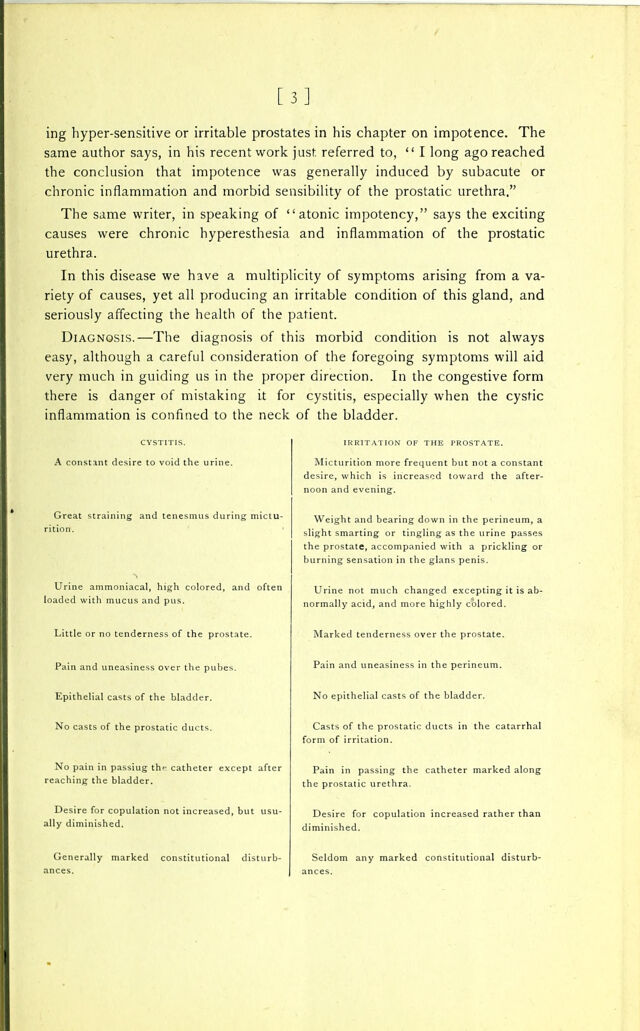
![[3] ing hyper-sensitive or irritable prostates in his chapter on impotence. The same author says, in his recent work just referred to, I long ago reached the conclusion that impotence was generally induced by subacute or chronic inflammation and morbid sensibility of the prostatic urethra. The same writer, in speaking of atonic impotency, says the exciting causes were chronic hyperesthesia and inflammation of the prostatic urethra. In this disease we have a multiplicity of symptoms arising from a va- riety of causes, yet all producing an irritable condition of this gland, and seriously affecting the health of the patient. Diagnosis.—The diagnosis of this morbid condition is not always easy, although a careful consideration of the foregoing symptoms will aid very much in guiding us in the proper direction. In the congestive form there is danger of mistaking it for cystitis, especially when the cystic inflammation is confined to the neck of the bladder. CYSTITIS. A constant desire to void the urine. Great straining and tenesmus during mictu- rition. Urine ammoniacal, high colored, and often loaded with mucus and pus. Little or no tenderness of the prostate. Pain and uneasiness over the pubes. Epithelial casts of the bladder. No casts of the prostatic ducts. No pain in passiug th>- catheter except after reaching the bladder. Desire for copulation not increased, but usu- ally diminished. Generally marked constitutional disturb- ances. IRRITATION OF THE PROSTATE. Micturition more frequent but not a constant desire, which is increased toward the after- noon and evening. Weight and bearing down in the perineum, a slight smarting or tingling as the urine passes the prostate, accompanied with a prickling or burning sensation in the glans penis. Urine not much changed excepting it is ab- normally acid, and more highly colored. Marked tenderness over the prostate. Pain and uneasiness in the perineum. No epithelial casts of the bladder. Casts of the prostatic ducts in the catarrhal form of irritation. Pain in passing the catheter marked along the prostatic urethra. Desire for copulation increased rather than diminished. Seldom any marked constitutional disturb- ances.](https://iiif.wellcomecollection.org/image/b22277171_0005.jp2/full/800%2C/0/default.jpg)