Licence: Public Domain Mark
Credit: Irritation of the prostate / by R. Harvey Reed. Source: Wellcome Collection.
Provider: This material has been provided by The Royal College of Surgeons of England. The original may be consulted at The Royal College of Surgeons of England.
4/8 page 4
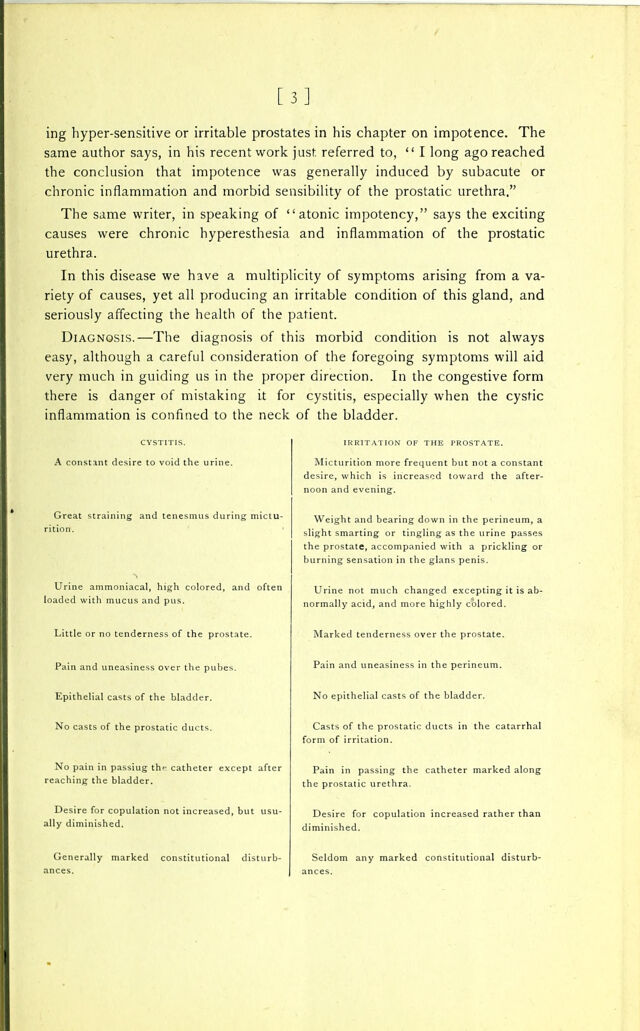
![[4] In the catarrhal form an examination with the bulbous bougie usually aid in the diagnosis. This may be done by swabbing out the urethra carefully several times with a bulbous bougie, after which by gently pass- ing a clean one past the gland and leaving it there until you pass the finger well into the rectum and keep up a process of kneading the gland gently, interchanging it for continued pressure ; after keeping that up for a few minutes, gradually remove the bougie while the finger is still in the rectum, and making firm pressure on the gland. An examination of the bulb of the bougie will generally reveal more or less exudation from the ducts of the gland; not unfrequently a partial mould of them. A microscopical examination of this exudation will reveal mucus, min- gled with epithelium cells, and in cases of long standing, occasional pus cells, mingled with crystals of magnesium phosphates or the triple phos- phates, all combining to form one heterogeneous mass, which seldom contains any spermatozoids, and when it does they are usually inactive. There is usually no marked, bloody or purulent discharge, or enlarge- ment of the fibrous structure of the gland, or the usual clear, trausparen; white of egg discharge, so common in prostatorrhea or interruption in the flow of the urine, which is usually not subjected to marked chemi- cal changes in the same, as is so commonly seen in acute or chronic pros- tatitis and cystitis. In hyperesthesia of the nerves supplying the prostate, we m,ay have all or part of the symptoms above described, but the most prominent symp- tom is the constant annoyance with nocturnal emissions, or almost unre- sistible desire for sexual intercourse under the least provocation, which often induces them to resort to masturbation or unrestramed sexual abuses, which only increases their difficulty. Prognosis.—In giving a prognosis in this disease, too much discretion cannot be used by the surgeon ; every part of the field must be diligently surveyed and carefully considered. Their habits, general health, mental and moral surroundings, will power, are all important factors, as well as the particular form of the disease; and unless the surgeon has taken all these into consideration, as well as that of having secured the entire con- fidence of the patient, he will be sadly disappointed if he relies on a favorable prognosis; otherwise, he can generally feel safe in giving his patient a fair amount of encouragement. Duration.—This difficulty may last for months, and even years, fluc- tuating up and down according to the surrounding circumstances of the patient.](https://iiif.wellcomecollection.org/image/b22277171_0006.jp2/full/800%2C/0/default.jpg)