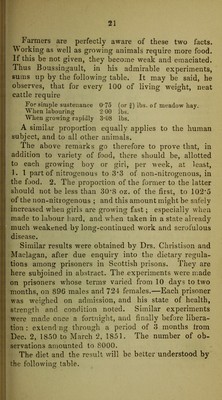
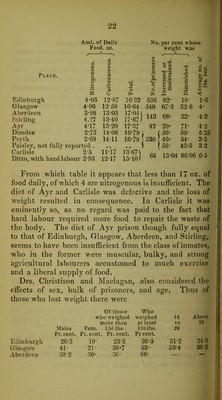
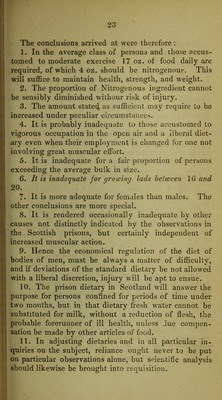
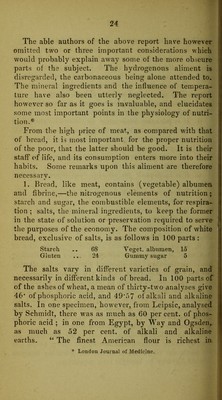
The cheapest and most nutritious food for charitable institutions and the poor : being the result of an inquiry, made by desire, on the food supplied to the Hill Street Female Refuge / by C.H.F. Routh.
- Routh, C. H. F. (Charles Henry Felix), 1822-1909
- Date:
- 1854
Licence: Public Domain Mark
Credit: The cheapest and most nutritious food for charitable institutions and the poor : being the result of an inquiry, made by desire, on the food supplied to the Hill Street Female Refuge / by C.H.F. Routh. Source: Wellcome Collection.
Provider: This material has been provided by The Royal College of Surgeons of England. The original may be consulted at The Royal College of Surgeons of England.
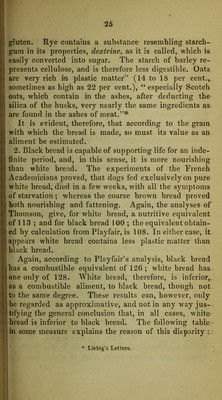
30/64 (page 26)
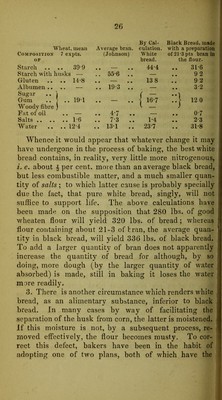
![By Cal- Black Bread, made Wheat, mean Average bran. culation. with a preparation Composition 7 expts. (Johnson) White of21-3pts bran in OF bread. the flour. Starch .. 39-9 .. — 44-4 31*6 Starch with husks — .. 55-6 .. — 92 Gluten .. 14-8 .. — 13 8 92 Albumen .. Sugar ., j .. — .. 19-3 .. ( — 3-2 Gum .. 191 .. — { 16-7 .A 12 0 Woody fibre ] Fat of oil .. 4-7 .. 1 _ J 0-7 Salts .. .. .. 7-3 .. 1-4 2-3 W ater .. 12-4 .. 131 .. 23*7 31-8 Whence it would appear that whatever change it may have undergone in the process of baking. the best white bread contains, in reality, very little more nitrogenous, i. e. about § per cent, more than an average black bread, but less combustible matter, and a much smaller quan- tity of salts ; to which latter cause is probably specially due the fact, that pure white bread, singly, will not suffice to support life. The above calculations have been made on the supposition that 280 lbs. of good wheaten flour will yield 320 lbs. of bread ; whereas flour containing about 21-3 of tran, the average quan- tity in black bread, will yield 336 lbs. of black bread. To add a larger quantity of bran does not apparently increase the quantity of bread for although, by so doing, more dough (by the larger quantity of water absorbed) is made, still in baking it loses the water more readily. 3. There is another circumstance wffiich renders white bread, as an alimentary substance, inferior to black bread. In many cases by way of facilitating the separation of the husk from corn, the latter is moistened. If this moisture is not, by a subsequent process, re- moved effectively, the flour becomes musty. To cor- rect this defect, bakers have been in the habit of adopting one of two plans, both of which have the j](https://iiif.wellcomecollection.org/image/b22316826_0032.jp2/full/800%2C/0/default.jpg)