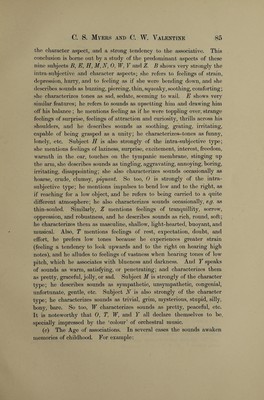
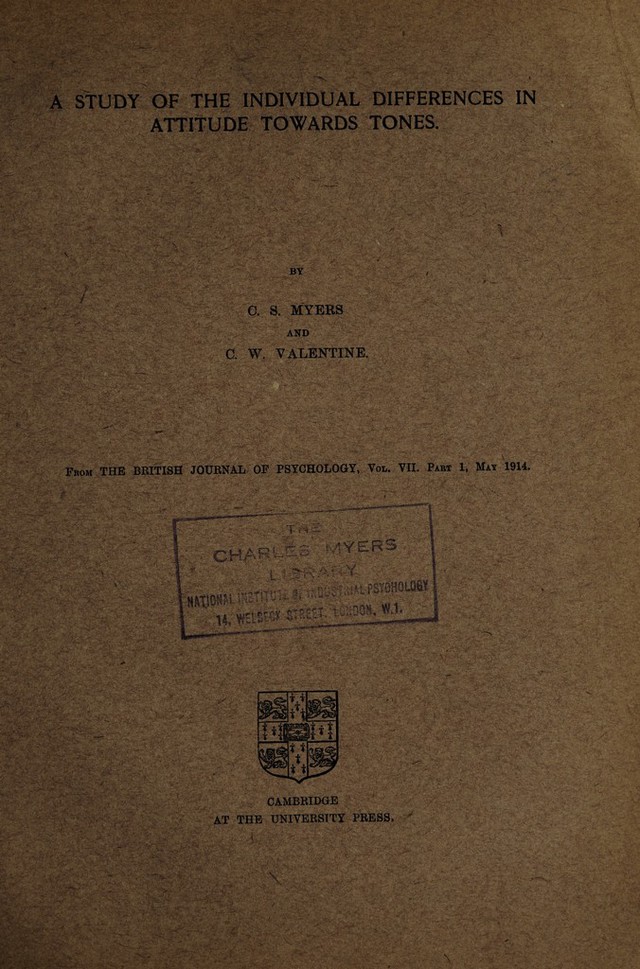
A study of the individual differences in attitude towards tones / by C.S. Myers and C.W. Valentine.
- Charles Samuel Myers
- Date:
- [1914?]
Licence: In copyright
Credit: A study of the individual differences in attitude towards tones / by C.S. Myers and C.W. Valentine. Source: Wellcome Collection.
24/52 page 86
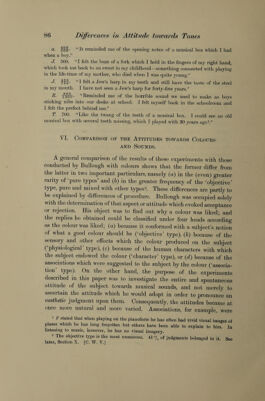
![reminded me of the opening notes of a musical box which I had when a boy.” J. 500. “I felt the buzz of a fork which I held in the fingers of my right hand, which took me back to an event in my childhood—something connected with playing in the life-time of my mother, who died when I was quite young.” J. “I felt a Jew’s harp in my teeth and still have the taste of the steel in my mouth. I have not seen a Jew’s harp for forty-five years.” “Reminded me of the horrible sound we used to make as boys sticking nibs into our desks at school. I felt myself back in the schoolroom and I felt the prefect behind me.” T. 700. “Like the twang of the teeth of a musical box. I could see an old musical box with several teeth missing, which I played with 30 years ago^” VI. Comparison of the Attitudes towards Colours AND Sounds. A general comparison of the results of these experiments with those conducted by Bullough with colours shows that the former differ from the latter in two impoitant particulars, namely (ft) in the (even) greater rarity of‘pure types’ and (b) in the greater frequency of the ‘objective’ type, puie and mixed with other typesThese differences are partly to be explained by differences of procedure. Bullough was occupied solely with the determination of that aspect or attitude which evoked acceptance or rejection. His object was to find out why a colour was liked; and the replies he obtained could be classihed under four heads according as the colour was liked; (ft) because it conformed with a subject’s notion of what a good colour should be (‘objective’ type), (b) because of the sensory and other effects which the colour produced on the subject (‘physiological’ type), (c) because of the human characters with which the subject endowed the colour (‘character’ type), or (d) because of the associations which were suggested to the subject by the colour (‘associa¬ tion’ type). On the other hand, the purpose of the experiments described in this paper was to investigate the entire and spontaneous attitude of the subject towards musical sounds, and not merely to ascertain the attitude which he would adopt in order to pronounce an aesthetic judgment upon them. Consequently, the attitudes became at once more natural and more varied. Associations, for example, were 1 F stated that when playing on the pianoforte he has often had vivid visual images of places which he has long forgotten but others have been able to explain to him. In listening to music, however, he has no visual imagery. The objective type is the most numerous. 41 °/q of judgments belonged to it. See later, Section X, [C. W. V.]](https://iiif.wellcomecollection.org/image/b30620715_0024.jp2/full/800%2C/0/default.jpg)