A study of the individual differences in attitude towards tones / by C.S. Myers and C.W. Valentine.
- Charles Samuel Myers
- Date:
- [1914?]
Licence: In copyright
Credit: A study of the individual differences in attitude towards tones / by C.S. Myers and C.W. Valentine. Source: Wellcome Collection.
30/52 page 92
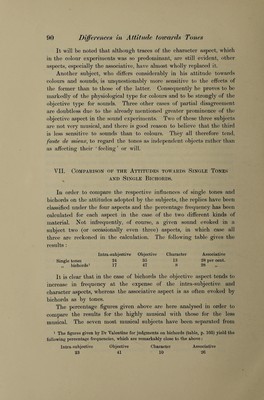
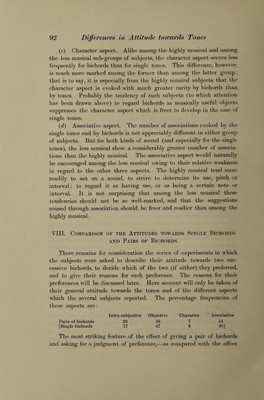
![(c) Character aspect. Alike among the highly musical and among the less musical sub-groups of subjects, the character aspect occurs less frequently for bichords than for single tones. This difference, however, is much more marked among the former than among the latter group; that is to say, it is especially from the highly musical subjects that the character aspect is evoked with much greater rarity by bichords than by tones. Probably the tendency of such subjects (to which attention has been drawn above) to regard bichords as musically useful objects suppresses the character aspect which is freer to develop in the case of single tones. {d) Associative aspect. The number of associations evoked by the single tones and by bichords is not appreciably different in either group of subjects. But for both kinds of sound (and especially for the single tones), the less musical show a considerably greater number of associa¬ tions than the highly musical. The associative aspect would naturally be encouraged among the less musical owing to their relative weakness in regard to the other three aspects. The highly musical tend more readily to act on a sound, to strive to determine its use, pitch or interval; to regard it as having use, or as being a certain note or interval. It is not surprising that among the less musical these tendencies should not be so well-marked, and that the suggestions roused through association should be freer and readier than among the highly musical. VIII. Comparison of the Attitudes towards Single Bichords AND Pairs of Bichords. There remains for consideration the series of experiments in which the subiects were asked to describe their attitude towards two sue- cessive bichords, to decide which of the two (if either) they preferred, and to give their reasons for such preference. 'I’he reasons for their preferences will be discussed later. Here account will only be taken of their general attitude towards the tones and of the different aspects which the several subjects reported. The percentage frequencies of these aspects are: Intra-subjective Objective Character Associative Pairs of bicbords 23 56 7 14 [Single bichords 17 47 8 28] The most striking feature of the effect of giving a pair of bichords and asking for a judgment of preference,—as compared with the effect](https://iiif.wellcomecollection.org/image/b30620715_0030.jp2/full/800%2C/0/default.jpg)