A study of the individual differences in attitude towards tones / by C.S. Myers and C.W. Valentine.
- Charles Samuel Myers
- Date:
- [1914?]
Licence: In copyright
Credit: A study of the individual differences in attitude towards tones / by C.S. Myers and C.W. Valentine. Source: Wellcome Collection.
41/52 page 103
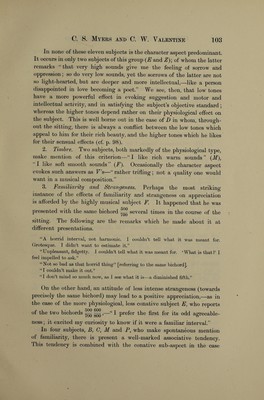
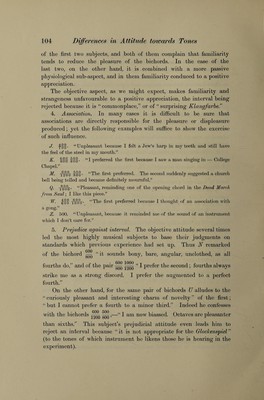
![In none of these eleven subjects is the character aspect predominant. It occurs in only two subjects of this group {E and Z)', of whom the latter remarks that very high sounds give me the feeling of sorrow and oppression; so do very low sounds, yet the sorrows of the latter are not so light-hearted, but are deeper and more intellectual,—like a person disappointed in love becoming a poet.” We see, then, that low tones have a more powerful effect in evoking suggestion and motor and intellectual activity, and in satisfying the subject’s objective standard; whereas the higher tones depend rather on their physiological effect on the subject. This is well borne out in the case of D in whom, through¬ out the sitting, there is always a conflict between the low tones which appeal to him for their rich beauty, and the higher tones which he likes for their sensual effects (cf p. 98). 2. Timbre. Two subjects, both markedly of the physiological type, make mention of this criterion—“I like rich warm sounds” {M), “ I like soft smooth sounds ” {F). Occasionally the character aspect evokes such answers as F’s—“ rather trifling; not a quality one would want in a musical composition.” 3. Familiarity and Strangeness. Perhaps the most striking instance of the effects of familiarity and strangeness on appreciation is afforded by the highly musical subject F. It happened that he was presented with the same bichord several times in the course of the sitting. The following are the remarks which he made about it at different presentations. “A horrid interval, not harmonic. I couldn’t tell what it was meant for. Grotesque. I didn’t want to estimate it.” “Unpleasant, fidgetty. I couldn’t tell what it was meant for. ‘What is that?’ 1 feel impelled to ask.” “Not so bad as that horrid thing” [referring to the same bichord]. “I couldn’t make it out.” “I don’t mind so much now, as I see what it is—a diminished fifth.” On the other hand, an attitude of less intense strangeness (towards precisely the same bichord) may lead to a positive appreciation,—as in the case of the more physiological, less conative subject E, who reports of the two bichords ^,—“ I prefer the first for its odd agreeable¬ ness ; it excited my curiosity to know if it were a familiar interval.” In four subjects, B, G, M and P, who make spontaneous mention of familiarity, there is present a well-marked associative tendency. This tendency is combined with the conative sub-aspect in the case](https://iiif.wellcomecollection.org/image/b30620715_0041.jp2/full/800%2C/0/default.jpg)