Remarks on the plague prophylactic fluid / by W.M. Haffkine.
- Haffkine, W. M. (Waldemar Mordecai Wolffe), 1860-1930.
- Date:
- [date of publication not identified]
Licence: Public Domain Mark
Credit: Remarks on the plague prophylactic fluid / by W.M. Haffkine. Source: Wellcome Collection.
5/8 page 1461
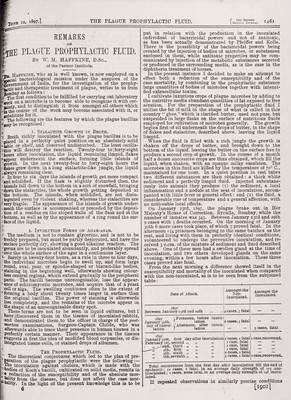
![fc. •June 12, i 897.] THE PLAGUE PROPHYLACTIC FLUID. r The British T 1 T [.Medical Journal atu1 REMARKS ON IXHE PLAGUE PROPHYLACTIC FLUID. IV. M. HAFFKINE, D.Sc., of the Pasteur Institute. By H Haffkine, who as is well known, is now employed on a »cial bacteriological mission under the auspices of the ‘Government of India, for the investigation of the prophy- pSctic and therapeutic treatment of plague, writes to us from Bombay as follows: A The first condition to be fulfilled for carrying out laboratory P«rork on a microbe is to become able to recognise it with cer- % *gjnty, and to distinguish it from amongst all others which 'in the course of the work may become associated with it, or gnbstitute for it. * The following are the features by which the plague bacillus *may be recognised: , t ■ 4 1. Stalactite Growth in Broth. ; Broth richly inoculated with the plague bacillus is to be •placed in a perfectly quiet position on an absolutely solid •table or shelf, and observed undisturbed. The least oscilla¬ tion will destroy the reaction. Twenty-four to[forty-eight ' hoars after inoculation, the liquid remaining limpid, flakes ^appear underneath the surface, forming little islands of growth. In the next twenty-four to forty-eight hours the flakes grow down in a long stalactite-like jungle, the liquid • always remaining clear. .« In four to six days the islands of growth get more compact I?and solidified. If the fiask is slightly disturbed then, the ! - islands fall down to the bottom in a sort of snowfall, bringing down the stalactites, the whole growth getting deposited at i the bottom. The islands, when solidified, are not disin- ; tegrated even by violent shaking, whereas the stalactites are • very fragile. The appearance of the islands of growth under¬ neath the surface is accompanied or preceded by the deposi- - tion of a residue on the sloped walls of the flask and at the G bottom, as well as by the appearance of a ring round the sur- I -faceof the liquid. u 2. Involution Forms on Agar-agar. * The medium is not to contain glycerine, and is not to be freshly prepared, but must be partly desiccated, and have the surface perfectly dry, showing a good alkaline reaction. The germs are to be inoculated abundantly, and preferably spread f over the whole surface of the agar in a continuous layer. L' Rarely in twenty-four hours, as a rule in three to four days, the individual microbes begin to swell up, and form large round, oval, pear, or spindle-shaped or biscuit-like bodies, • staining in the beginning well, afterwards showing colour¬ less central regions, which extend gradually to the peripheral parts. The bacilli become unrecognisable, lose the appear- 4 ance of schizomycetic microbes, and acquire that of a yeast cell or alga. The swelling continues often to the extent of * forming a body about twenty times larger in surface than the original bacillus. The power of staining is afterwards lost completely, and the remains of the microbe appear in the shape of an unrecognisable dusty spot. These forms are not to be seen in liquid cultures, but I have [discovered them in the tissues of inoculated rabbits, and demonstrated them to the officer in charge of the post¬ mortem examinations, Surgeon-Captain Childe, who was afterwards able to trace their presence in human tissues in a perfectly certain manner. Their appearance in the tissues r suggests at first the idea of modified blood corpuscles, or dis¬ integrated tissue cells, or stained drops of albumen. L The Prophylactic Fluid. The theoretical conjectures which led to the plan of pre¬ paration of the plague prophylactic were the following:— ■ The inoculation against cholera, which is made with the bodies of Koch’s bacilli, cultivated on solid media, results in ’a reduction of the susceptibility and of the absolute mor- ^talityfrom the disease, but does not affect the case mor- ^tality. In the light of the present knowledge this is to be put in relation with the production in the inoculated individual of bactericidal powers and not of antitoxic, as has been actually demonstrated by Pfeiffer and Kolle. There is the possibility of the bactericidal powers being created by the injection of bodies of microbes, or substances enclosed in them, while antitoxic properties may be com¬ municated by injection of the metabolic substances secreted or produced in the surrounding media, as is the case in the diphtheria treatment of horses. In the present instance I decided to make an attempt to effect both a reduction of the susceptibility and of the case mortality, by combining in the prophylactic substance large quantities of bodies of microbes together with intensi¬ fied extracellular toxins. I cultivate luxurious crops of plague microbes by adding to the nutritive media abundant quantities of fat exposed to free aeration. For the preparation of the prophylactic fluid I utilise the fat of milk in the shape of what is called in this country “ ghee,” which is clarified butter, used not pure, but suspended in large flasks on the surface of nutritious fluids employed for cultivation of microbes generally. The growth begins first of all underneath the drops of butter, in the shape of flakes and stalactites, described above, leaving the liquid limpid. When the fluid is filled with a rich jungle the growth is shaken off the drops of butter, and brought down to the bottom of the liquid, leaving the butter on the surface free to produce a second crop of growth. In the course of a month half a dozen successive crops are thus obtained, which fill the liquid, when shaken, with an opaque milky emulsion. The microbes in this fluid are killed by the temperature of jo° C., maintained for one hour. In a quiet position in test tubes two different substances are then obtained: a thick white sediment and a perfectly limpid fluid. Injected subcutane¬ ously into animals they produce (i) the sediment, a local inflammation and a nodule at the seat of inoculation, accom¬ panied with little fever or general effect: and (2) the fluid, a considerable rise of temperature and a general affection, with no noticeable local effects. On January 23rd, 1S97, the plague broke out in Her Majesty’s House of Correction, Byculla, Bombay, while the number of inmates was 345. Between January 23rd and 29th 9 cases with 5 deaths occurred. On the morning of January 30th 6 more cases took place, of which 3 proved fatal. In the afternoon 154 prisoners belonging to the same batches as the rest, and living with them in perfectly identical conditions, volunteered to undergo the preventive inoculation, and re¬ ceived 3 c.cm. of the mixture of sediment and fluid described above. One of these men had a swollen gland at the time of inoculation, and two others developed glands on the same evening, within a few hours after inoculation. These three cases proved also fatal. From the next morning a difference showed itself in the susceptibility and mortality of the inoculated when compared with the non-inoculated, as is to be seen from the subjoined table: Date of Attack. ... - a Amongst the Non- inoculated. Amongst the Inoculated. 1897 Between January 23rd and 29th . 9 cases, s fatal — — 1897 j Forenoon, before inocu- January 30th, f lation day of inocu- 1 Afternoon, after modu¬ lation ) lation 6 cases, 3 fatal 3 cases, fatal 1897 January 31st, first day after inoculation February 1st, second ,, ,, ,, n ,, ^...2nd, third „ „ ,, —4th, fifth ,, ,, ,, ,, 5th, sixth ,, „ >* ,, 6th,seventh,, ,, ,, 2’cases, 1 fatal 1 case, fatal 1 case, fatal 1 case, fatal 2 cases, 1 fatal 5 cases, 1 fatal 1 case,recovered. 1 case,recovered. Total occurrences from the first day after inoculation till the end of epidemic: 12 cases, 6 fatal, in an average daily strength of 173 non- inoculated ; 2 cases, none fatal, in an average daily strength of 148 inocu¬ lated. If repeated observations in similarly precise conditions [1902]](https://iiif.wellcomecollection.org/image/b30476902_0005.jp2/full/800%2C/0/default.jpg)