Remarks on the plague prophylactic fluid / by W.M. Haffkine.
- Haffkine, W. M. (Waldemar Mordecai Wolffe), 1860-1930.
- Date:
- [date of publication not identified]
Licence: Public Domain Mark
Credit: Remarks on the plague prophylactic fluid / by W.M. Haffkine. Source: Wellcome Collection.
7/8 page 1462
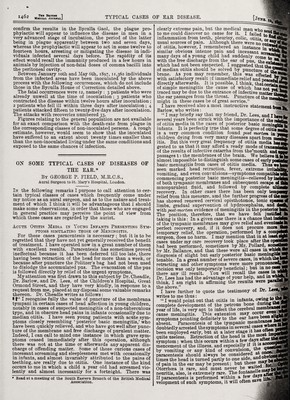
![1462 Th* British “j MlDIClX JonBHUJ TYPICAL CASES OF EAR DISEASE. confirm the results in the Byculla Gaol, the plague pro¬ phylactic will appear to influence the disease in men in a very advanced stage of incubation, the period of the latter being in plague apparently between two and seven days, whereas the prophylactic will appear to act in some twelve to fourteen hours, arresting or mitigating the disease in indi¬ viduals infected several days before. The rapidity of its effect would recall the immunity produced in a few hours in animals by injection of non-fatal doses of comma bacilli into the peritoneal cavity. Between January 10th and May 6th, 1897, 11,362 individuals from the infected areas have been inoculated by the above process with the following occurrences, which do not include those in the Byculla House of Correction detailed above. The fatal occurrences were 12, namely : 3 patients who were already unwell at the time of inoculation ; 3 patients who contracted the disease within twelve hours after inoculation ; 2 patients who fell ill within three days after inoculation ; 4 patients attacked fifteen to twenty-five days after inoculation. The attacks with recoveries numbered 33. Figures relating to the general population are not available for an exact comparison with the death-rate from plague in the corresponding classes of non-inoculated persons. A rough estimate, however, would seem to show that the inoculated have suffered to an extent about twenty times smaller than than the non-inoculated living under the same conditions and exposed to the same chances of infection. ON SOME TYPICAL CASES OF DISEASES OF THE EAR.* By GEORGE P. FIELD, M.R.C.S., Aural Surgeon to St. Mary's Hospital, Loudon. In the following remarks I purpose to call attention to cer¬ tain typical classes of cases which frequently come under my notice as an aural surgeon, and as to the nature and treat¬ ment of which I think it will be advantageous that 1 should make some observations, in order that those who are engaged in general practice may perceive the point of view from which these cases are regarded by the aurist. Acute Otitis Media in Young Infants Presenting Sym¬ ptoms SIMULATING THOSE OF MENINGITIS. For these cases paracentesis is necessary ; but it is to be regretted that they have not yet generally received the benefit of treatment. I have operated now in a great number of them with excellent results. Paracentesis has sometimes proved ineffectual because it has been deferred till too late, there having been retraction of the head for more than a week, or because after puncture the Politzer’s bag had not been used to dislodge the accumulated pus. The evacuation of the pus is followed directly by relief of the urgent symptoms. My attention was first drawn to this subject by Dr. Cheadle, Dr. Barlow, and Dr. Lees, of the Children’s Hospital, Great Ormond Street, and they have very kindly, in response to a request from me, placed at my disposal some valuable remarks thereon. Dr. Cheadle writes as follows : 18“ I recognise fully the value of puncture of the membrana tympani in certain cases of head affection in young children, notably in cases of suspected meningitis of a non-tuberculous type, and in obscure head pains in infants occasionally due to median otitis. I have seen young patients with acute sym¬ ptoms closely resembling ‘ posterior basic meningitis/ who have been quickly relieved, and who have got well after punc¬ ture of the membrane and free discharge of purulent matter. Indeed, I can call to mind one instance in which grave sym¬ ptoms ceased immediately after this operation, although there was not at the time or afterwards any apparent dis¬ charge of offending matter. Some of those curious cases of incessant screaming and sleeplessness met with occasionally in infants, and almost invariably attributed to the pains of teething, are really due to otitis. One instance of the kind occurs to me in which a child a year old had screamed vio¬ lently and almost incessantly for a fortnight. There was * Read at a meeting of the South Eastern Branch of the British Medical Association. clearly extreme pain, but the medical man who - to me could discover no cause for it. I failed inflammation from teeth, pleurisy, colic, otitia 0-*^^ usual sources of pain. Although there were nooutlaZi” of otitis, however, I remembered an instance in similar obvious intense pain and incessant sc^e^w*1*' many days of a young child had suddenly come t!? with the free discharge from the ear of pus, the eri which had not been suspected. I suggested that the of median otitis should be solved by puncture of tiET brane. As you may remember, this was effected0*1 with satisfactory result of immediate relief and peace, directly afterwards. It is possible, I think, that certain of simple meningitis the cause of which has not jet traced may be due to the entrance of infective matteri the ear passages from the throat. Puncture of the might in these cases be of great service.” I have received also a most instructive statement Barlow, who writes : “ I may briefly say that my friend, Dr. Lees, and Ih»*i several years been struck with the importance of therSS of otitis media in the cases of posterior basic meninriKl infants. It is perfectly true that some degree of otiUtaS is a very common condition found post mortem in ^ children dying from very many diseases apart from itis. But this very great frequency of otitis media h*] gested to us that it may afford a ready mode of tn of the results of infective catarrhs from the’mouth andi passages t > the membranes of the brain. We believe ill almost impossible to distinguish some cases of early j ‘ basic meningitis from cases of otitis media. Thus seen marked head retraction, fever, extreme irxit vomiting, and even convulsions—symptoms compatibkM commencing posterior basic meningitis—relieved by ind of both tympanic membranes and subsequent escape of mucopurulent fluid, and followed by complete nil recovery. In other cases there has been only tempHpf| relief from this measure, amd the further progress of has showed renewed cervical opisthotonos, tonic spa limbs, gradual supervention of hydrocephalus, and with post-mortem evidence of meningitis in the posteriori The position, therefore, that we have felt justf-‘J taking is this : In a given case there is a chance that: of the tympanic membranes may give relief and eventwtol perfect recovery, and, if it does not procure moift: temporary relief, the operation, performed by a com] surgeon, does no harm. I may mention that in at least < cases under my care recovery took place after the oj had been performed, sometimes by Mr. Pollard, soe^ by Mr. Ballance, and that these were all cases m whicft wm:. diagnosis of slight but early posterior basic memngiU#5 tenable. In a great number of severe cases, in which tut *1 retracting and other symptoms were more pronounced* 1 incision was only temporarily beneficial; but in no CMt.* there any ill result. You will recall the cases in wm Dr. Lees has had the advantage of your help, and in^ think, I am right in affirming the results were the above.” . ~ I have further to quote the testimony of lg*. writes to me thus: , “ I would point out that otitis in infants, owing complete development of the petrous bone hanng year of life, is very apt to infect the cerebral mer j cause meningitis. This extension may occur evoaf symptoms pointing definitely to the ear have been absent. Paracentesis of the tympanic membranes^ doubtedly arrested the symptoms in several cases ^ been employed early, but at a later stage it has o . quite useless. Retraction of the head is the mo symptom; when this occurs within a few days mencement of the illness, and especially if 18 by vomiting or any kind of convulsion, tne q paracentesis should always be considered a P3BB times the head is turned partly to one side, 311 -.hag*- of pain in the ear may be present; but these Otorrhcea is rare, and must never be wait neuritis, also, is extremely rare. The fontanel If paracentesis is performed within a few day velopment of such symptoms, it will often sav](https://iiif.wellcomecollection.org/image/b30476902_0007.jp2/full/800%2C/0/default.jpg)
 No text description is available for this image
 No text description is available for this image
 No text description is available for this image