On the hours of sleep at public schools : based on an inquiry into the arrangements existing in forty of the great public schools in England, and others in the U.S.A. : a paper read before the Association on May 11, 1905 / by T.D. Acland.
- Acland, Theodore Dyke, 1851-1931.
- Date:
- 1905
Licence: In copyright
Credit: On the hours of sleep at public schools : based on an inquiry into the arrangements existing in forty of the great public schools in England, and others in the U.S.A. : a paper read before the Association on May 11, 1905 / by T.D. Acland. Source: Wellcome Collection.
Provider: This material has been provided by The Royal College of Surgeons of England. The original may be consulted at The Royal College of Surgeons of England.
2/40
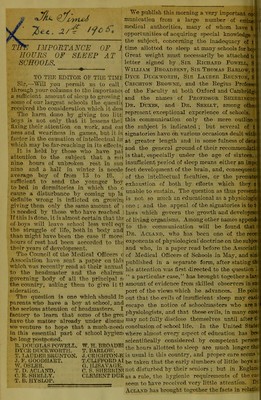
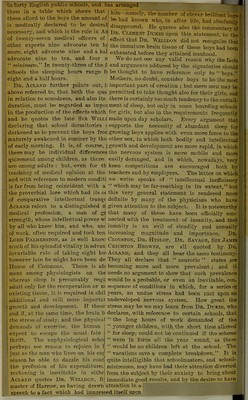
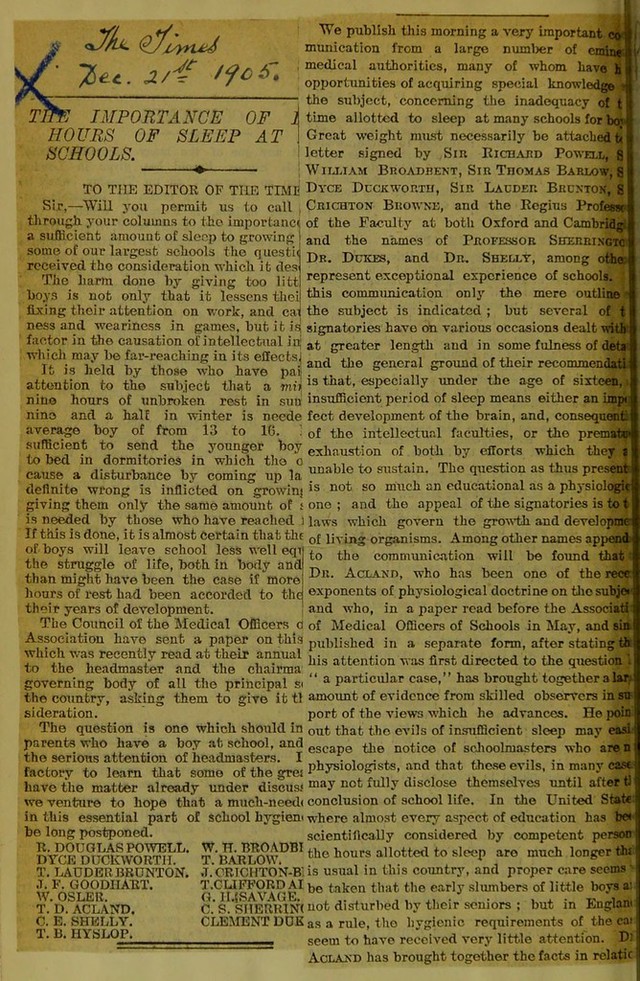
![<*yh- Q*fivrud ^ec. J/i' ffos: Tim IMPORTANCE OF ] HOURS OF SLEEP AT SCHOOLS. TO TIIE EDITOR OF THE TIME Sir,—Will you permit us to call , through your columns to the importance a sufficient amount of sleep to growing some of our largest schools the questii received the consideration which it des The harm done by giving too litt boys is not only that it lessens thei fixing their attention on work, and cai ness and weariness in games, but it is factor in the causation of intellectual in which may be far-reaching in its effects] It is held by those who have pai| attention to the subject that a mii nine hours of unbroken rest in sun nine and a half in winter is neede average boy of from 13 to 10. sufficient to send the younger boy to bed in dormitories in which the o cause a disturbance by coming up la definite wrong is inflicted on growini giving them only the same amount of s is needed by those who have reached ) If this is done, it is almost Certain that tilt of boys will leave school less well eqi the struggle of life, both in body and than might have been the case if more hours of rest had been accorded to the their years of development. The Council of the Medical Officers d Association have sent a paper on this which was recently read at their annual to the headmaster and the chairma governing body of all the principal si the country, asking them to give it tl sideration. The question is one which should in parents who have a boy at school, and the serious attention of headmasters. I factory to learn that some of the gre; have the matter already under discus.* we venture to hope that a much-needi in this essential part of school bygiem be long postponed. R. DOUGLAS POWELL. W. TL BROADBI DYCE DUCKWORTH. T. BARLOW. T. LAUDERBRUNTON. .T. CRIOHTON-B' .1. F. GOODIIART. T.CLIFFORD AI W. OSLER, G. II.SSAVAGE. T. D. ACLAND. C. S. SHEURINf C. E. SHELLY. CLEMENT DUE T. B. HYSLOP. We publish this morning a very important co l| munication from a large number of emine medical authorities, many of whom have h opportunities of acquiring special knowledge * the subject, concerning the inadequacy of 1 time allotted to sleep at many schools for ber Great weight must necessarily be attached h letter signed by Sin Richard Powell, S William Broadbent, Sir Thomas Barlow, S Dyce Duckworth, Sir Lauder Bhunton, s Crichton Browne, and the Begins Professe of the Faculty at both Oxford and Cambridge and the names of Professor Suerringtc Dr. Dukes, and Dr. Shelly, among othe. represent exceptional experience of schools, this communication only the mere outline the subject is indicated ; but several of 1 signatories have on various occasions dealt with at greater length and in some fulness of deta and the general ground of their recommendatl is that, especially under the age of sixteen, insufficient period of sleep means either an imp feet development of the brain, and, consequent of the intellectual faculties, or the prematep exhaustion of both by efforts which they a unable to sustain. The question as thus present is not so much an educational as a physiologic one ; and the appeal of the signatories is to i laws which govern the growth and developmo I of living organisms. Among other names append to the communication will be found that Dn. Acland, who has been one of the rece exponents of physiological doctrine on the subje* and who, in a paper read before the Associat of Medical Officers of Schools in May, and sin published in a separate form, after stating tb his attention was first directed to the question “ a particular ease,” has brought together alar amount of evidence from skilled observers in su port of the views which he advances. He poin out that t.he evils of insufficient sleep may eas escape the notice of schoolmasters who are n physiologists, and that these evils, in many cast may not fully disclose themselves until after t conclusion of school life. In the United State where almost every aspect of education has be< scientifically considered by competent person | the hours allotted to sleep aro much longer flu is usual in this country, and proper care seems ’ be taken that the early slumbers of little boys a' not disturbed by their seniors ; but in Englam as a rule, the hygienic requirements of the eai seem to have received very little attention. Dj Acland has brought together the facts in relatic'](https://iiif.wellcomecollection.org/image/b22396895_0004.jp2/full/800%2C/0/default.jpg)