Drugs and medicines of North America : a publication devoted to the historical and scientific discussion of botany, pharmacy, chemistry and therapeutics of the medical plants of North America, their constituents, products and sophistications.
- Date:
- 1884-1887
Licence: Public Domain Mark
Credit: Drugs and medicines of North America : a publication devoted to the historical and scientific discussion of botany, pharmacy, chemistry and therapeutics of the medical plants of North America, their constituents, products and sophistications. Source: Wellcome Collection.
152/354 (page 126)
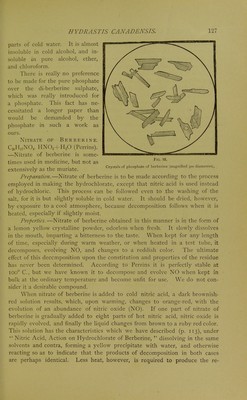
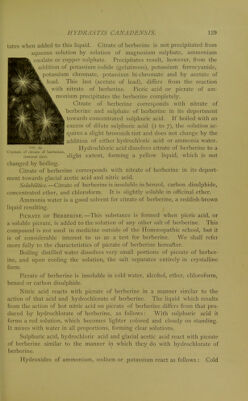
![litmus and a normal solution of sulphuric acid was allowed to flow into it from a burette until a permanent pink hue resulted. The number of C. c. of normal acid solution required, deducted from the number of C. c. of the alkaline solution, was accepted as giving the amount of the latter required for the exact neutralization of the phosphoric acid; one C. c. of the normal alkali corres- ponding to 0.327 grams of anhydrous phosphoric acid. SUMMARY OF THIS EXPERIMENT. 1.2421 grams of H3P04 were contained in the 2 grams of acid used. 0.6638 remained uncombined. 0-5783 combined with the 0.280 grams berberine. 42.3 C. c. of normal solution NaOH used to neutralize the free acid. 22.0 H3S04 excess of NaOH. 20.3 C. c. amount required for exact neutralization of uncombined H3P04. Hence, 20.3 C. c. X -0327=0.6638 grams of H3P04 uncombined. Four more experiments were made with the following result: Experiment. No. I. 0.280 grams berberine C20H17NO4 yielded of H3P04 0.5790 grams. No. 2. 0.280 0.5788 No. 3. 0.280 0.5787 « No. 4. 0.280 «« « 0.5788 « If one molecule C20H]7NO4 (335) combines with one molecule of H3 P04 (99), then 0.280 gram alkaloid would require 0.827, but we find practi- cally that 0.280 gram of the alkaloid combines with on an average 0.5788 gram of the acid. Then, as 0.5788-^.0827 equals about seven, hence if theoretically 0.5792 gram of the acid combine with .280 gram of the alka- loid, and practically the amount found is about 0.5788 of acid, the formula must then be C20H17NO4.7H3PO4. Properties.—Phosphate of berberine is a canary yellow powder, odorless and bitter. It changes to olive green when heated above 700 C, and gives up its water of crystallization at ioo° C. It absorbs water upon exposure, and changes to a darker yellow, but does not deliquesce. Crystallized from hot alcohol, it forms irregular prismatic crystals. (P. and W.) The crystalline structure of phosphate of berberine is represented by the micro-drawings (Fig. 38) made for our publication by Mr. W. J. Huck, under the direction of Prof. F. B. Power, who writes of them as follows: The crystals are much broader than those of the preceding salts in consequence of the coalescence of several crystals, and the ends are very irregular in outline. Solubilities.—One part of the crystallized salt dissolved in 10.43 parts of cold water. One part of the salt dried at a temperature of 100° C. dissolved in 21.52](https://iiif.wellcomecollection.org/image/b20414535_0152.jp2/full/800%2C/0/default.jpg)