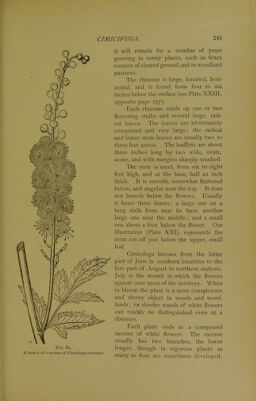
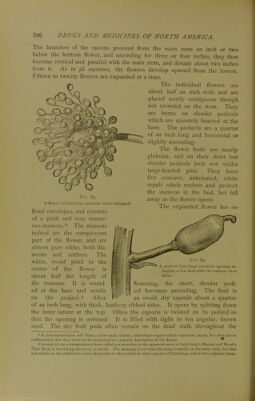
Drugs and medicines of North America : a publication devoted to the historical and scientific discussion of botany, pharmacy, chemistry and therapeutics of the medical plants of North America, their constituents, products and sophistications.
- Date:
- 1884-1887
Licence: Public Domain Mark
Credit: Drugs and medicines of North America : a publication devoted to the historical and scientific discussion of botany, pharmacy, chemistry and therapeutics of the medical plants of North America, their constituents, products and sophistications. Source: Wellcome Collection.
291/354 (page 247)
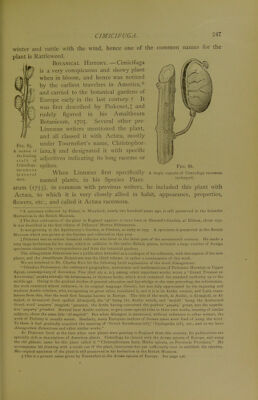
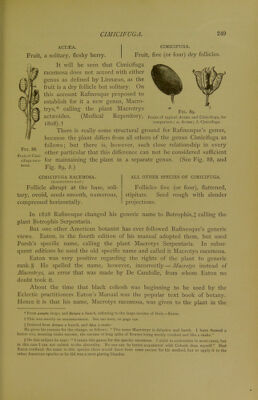
![winter and rattle with the wind, hence one of the common names for the plant is Rattleweed. Botanical History.—Cimicifuga is a very conspicuous and showy plant when in bloom, and hence was noticed by the earliest travelers in America,* and carried to the botanical gardens of Europe early in the last century, f It was first described by Plukenet, £ and rudely figured in his Amaltheum Botanicum, 1705. Several other pre- Linnaean writers mentioned the plant, and all classed it with Actaea, mostly under Tournefort's name, Christophor- a section of iana, § and designated it with specific fta^k'Tf adjectives indicating its long raceme or Cimicifuga spikes. (natural When Linnaeus first specifically sIze)- named plants, in his Species Plant- Fig. 86. A single capsule of Cimicifuga racemosa (enlarged). arum (1753), in common with previous writers, he included this plant with Actaea, to which it is very closely allied in habit, appearance, properties, flowers, etc., and called it Actaea racemosa. *A specimen collected by Fisher, in Maryland, nearly two hundred years ago, is still preserved in the Solander Herbarium in the British Museum. 'I The first cultivation of the plant in England appears to have been in Sherard's Garden, at Eltham, about 1732. It was described in the first edition of Dillenius' Hortus Elthamensis. It was growing in the Apothecary's Garden, at Chelsea, as early as 1737. A specimen is preserved in the British Museum which was grown in the Garden and collected in that year. J Plukenet was an ardent botanical collector who lived in the latter part of the seventeenth century. He made a very large herbarium for his time, which in addition to the native British plants, included a large number of foreign specimens obtained by correspondence and from the botanical gardens. The Almagestum Botanicum was a publication intended as a catalogue of his collection, with description of the new plants, and the Amaltheum Botanicum was the third volume or rather a continuation of this work. We are indebted to Dr. Charles Rice for the following lucid explanation of the word Almagestum: Claudius Ptolemaeus, the celebrated geographer, astronomer and mathematician of Ptolemais Hermion in Upper Egvpt, contemporary of Antoninus Pius (died 161 a. d.), among other important works, wrote a ' Grand Treatise on Astronomy,' (xeyaAjj crufTafis rr/s ao-Tpouo/uta?, in thirteen books, which work remained the standard authority up to the middle age. Owing to the gradual decline of general education and knowledge in the time preceding the reformation, the work remained almost unknown, in its original language (Greek), but was duly appreciated by the inquiring and studious Arabic scholars, who, recognizing its great value, translated it, and it is in its Arabic version, and Latin trans- lations from this, that the work first became known in Europe. The title of the work, in Arabic, is Al-majisti, or Al- mijisti, or Al-majust! [best spelled Al-mcjisli], the ' al' being the Arabic article, and 'mcjisti' being the Arabicised Greek word ' p.tyiart\' (megistg) 'greatest, the Arabs having converted the positive ' titydXy' great, into the superla- tive ' neyuTTy' greatest. Several later Arabic authors, to give some special eclat to their own works, treating of similar subjects, chose the same title 'Al-majisti.' But when Almagest is mentioned, without reference to other writers, the work of Ptolemy is usually meant. Similarly, many European authors of former times were fond of using the word. To them it had gradually acquired the meaning of ' Grand Storehouse [of],' ' Cyclopedia [of], etc., and so we have Almagestum Botanicum and other similar works. As Plukenet lived at the time when new plants were pouring to England from this country, his publications are specially rich in descriptions of American plants. Cimicifuga he classed with the Actaea spicata of Europe, and using the old generic name for this plant called it Christophoriana facie, Herba spicata, ex Provincia Floridana.'' He accompanies his drawing with a crude cut of the plant, inaccurate but yet sufficiently true to establish the identity. His original specimen of the plant is still preserved in his herbarium in the British Museum. '$ This is a generic name given by Tournefort to the Actaea spicata of Europe. See page 236.](https://iiif.wellcomecollection.org/image/b20414535_0293.jp2/full/800%2C/0/default.jpg)