Dangerous trades: the historical, social and legal aspects of industrial occupations as affecting health / by a number of experts ; edited by Thomas Oliver.
- Date:
- 1902
Licence: In copyright
Credit: Dangerous trades: the historical, social and legal aspects of industrial occupations as affecting health / by a number of experts ; edited by Thomas Oliver. Source: Wellcome Collection.
Provider: This material has been provided by Royal College of Physicians, London. The original may be consulted at Royal College of Physicians, London.
89/978 (page 61)
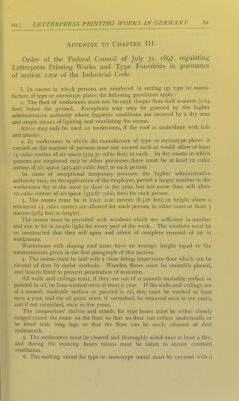
![hi.] LETTERPRESS PRINTING WORKS IN GERMANY Appendix to Chapter III. Order of the Federal Council of July 31, 1897, regulating Letterpress Printing Works and Type Foundries in pursuance of section 1202 of the Industrial Code. I. In rooms in which persons are employed in setting up type or manu- facture of type or stereotype plates the following provisions apply : 1. The floor of workrooms must not be sunk deeper than half a metre (1.64 feet) below the ground. Exceptions may only be granted by the higher administrative authority where hygienic conditions are secured by a dry area and ample means of lighting and ventilating the rooms. Attics may only be used as workrooms, if the roof is underdone with lath and plaster. 2. In workrooms in which the manufacture of type or stereotype plates is carried on the number of persons must not exceed such as would allow at least 15 cubic metres of air space (529.31 cubic feet) to each. In the rooms in which persons are employed only in other processes there must be at least 12 cubic metres of air space (423.450 cubic feet) to each person. In cases of exceptional temporary pressure the higher administrative authority may, on the application of the employer, permit a larger number in the workrooms for at the most 30 days in the year, but not more than will allow 10 cubic metres of air space (352.87 cubic feet) for each person. 3. The rooms must be at least 2.90 metres (8.528 feet) in height where a minimum 15 cubic metres are allowed for each person, in other cases at least 3 metres (9.84 feet in height). The rooms must be provided with windows which are sufficient in number and size to let in ample light for every part of the work. The windows must be so constructed that they will open and admit of complete renewal of air in workrooms. Workrooms with sloping roof must have an average height equal to the measurements given in the first paragraph of this section. 4. The rooms must be laid with a close fitting impervious floor which can be cleared of dust by moist methods. Wooden floors must be smoothly planed, and boards fitted to prevent penetration of moisture. All walls and ceilings must, if they are not of a smooth washable surface or painted in oil, be lime-washed once at least a year. If the walls and ceilings are of a smooth washable surface or painted in oil, they must be washed at least once a year, and the oil paint must, if varnished, be removed once in ten years, and if not varnished, once in five years. The compositors’ shelves and stands for type boxes must be either closely ranged round the room on the floor so that no dust can collect underneath, or be fitted with long legs so that the floor can be easily cleaned of dust underneath. 5. The workrooms must be cleared and thoroughly aired once at least a day, and during the working hours means must be taken to secure constant ventilation. 6. The melting vessel for type or stereotype metal must be covered with a](https://iiif.wellcomecollection.org/image/b23983747_0089.jp2/full/800%2C/0/default.jpg)